
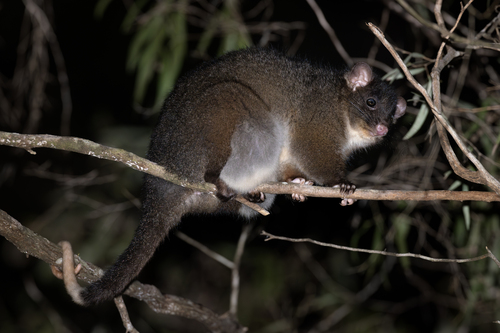
Greater Glider
Petauroides volans
Photo: Wikimedia Commons (CC) via https://en.wikipedia.org/wiki/Southern_greater_glider
Overview
Petauroides volans is the largest gliding marsupial in Australia, using a furred membrane stretched between its elbows and ankles to glide between eucalypt trees, sometimes covering distances exceeding 90 metres in a single glide. Nocturnal and largely solitary, it feeds almost exclusively on eucalypt leaves, relying on a specialised digestive system to process this low-nutrient diet. By day it shelters in hollows found only in mature and old-growth trees, a dependency that makes it particularly sensitive to forest structure and age.
As a specialist herbivore, it plays a role in nutrient cycling within its forest ecosystem and serves as an indicator of forest health.
The species is endemic to the eucalypt forests of eastern Australia, ranging from north Queensland through New South Wales into Victoria, at elevations from lowland forests to cooler upland regions.
Its decline is driven by the loss of hollow-bearing trees through logging, land clearing for agriculture, and infrastructure development including roads. Large-scale bushfires, intensified by prolonged drought and rising temperature extremes linked to climate change, have destroyed significant areas of habitat in recent years, compounding losses from historic timber harvesting. Fragmentation from roads and agricultural expansion further isolates populations, limiting genetic exchange and recolonisation after disturbance.
Conservation responses include protections for hollow-bearing trees in some forestry areas, expansion of protected forest reserves, post-fire habitat assessments, and research into nest box supplementation and thermal tolerance. Some Australian states have moved to restrict native forest logging in key habitat areas.
The population is assessed as decreasing, and continued habitat loss, fire frequency, and climate pressures suggest ongoing range contraction unless current protective measures are substantially strengthened and expanded.
Greater Gliders are losing their forest homes as trees are cut down for timber and cleared for farming, while roads and railways break up the remaining forest into smaller, disconnected patches. Climate-related pressures like worsening droughts, extreme heat, and more frequent or intense bushfires are making it harder for these tree-dependent animals to find food, shelter, and safe habitat. Overall, these combined pressures appear to be intensifying rather than easing.
Habitat
Conservation measures underway
Other threatened species in PSEUDOCHEIRIDAE
Threatened in Australia
Frequently asked questions
Why is Greater Glider classified as Endangered?
Where does Greater Glider live?
What are the main threats to Greater Glider?
Get weekly conservation intelligence
One short digest a week of the most striking species and country data we ship, plus breaking conservation news paired with our database where it matters.
Free, no spam. One-click unsubscribe in every email.