
Pavona duerdeni
Photo: Wikimedia Commons (CC) via https://en.wikipedia.org/wiki/Pavona_duerdeni
Overview
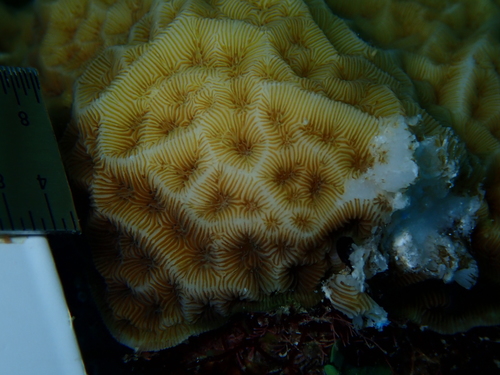
Pavona duerdeni is a reef-building coral in the family Agariciodae, forming colonies with a distinctive laminar or encrusting growth pattern that develops into thick, whorled plates. Like other scleractinian corals, it relies on a symbiotic relationship with photosynthetic zooxanthellae housed within its tissues, which supply the majority of its energy needs while the coral itself extends polyps to capture plankton at night. Colonies contribute to the physical structure of reef systems, providing habitat complexity that supports fish and invertebrate communities.
The species occurs across a broad but patchy range in the Indo-Pacific and eastern Pacific, with recorded populations in the United States, Australia, Ecuador, Vietnam, Panama, Taiwan, China, and Japan. It inhabits shallow marine neritic waters, typically on reef slopes and other hard-bottom substrates within the photic zone.
Population trends are declining, and the species is listed as Endangered. Threats are numerous and cumulative: coral harvesting and fishing pressure, damage from recreational activities such as diving and anchoring, disease outbreaks linked to native and invasive species, nutrient pollution from urban wastewater and agricultural runoff, and broader habitat degradation driven by shifting environmental conditions, including warming seas and changing water chemistry. Unrecorded pollution sources add further uncertainty to the scale of impact.
Conservation efforts rely largely on existing marine protected areas and international frameworks restricting coral trade and harvest, alongside water-quality management programs in some range states. Targeted, species-specific interventions remain limited. Given the combination of localized human pressures and larger-scale climate-related stressors, the species' outlook remains poor, with continued population decline anticipated unless threats are substantially reduced.
This coral species faces ongoing pressure from fishing and harvesting activities, pollution from sewage and farm runoff, and damage caused by recreational activities like diving or boating in its habitat. It is also threatened by invasive species, disease, and changes to its natural environment, including shifts caused by coastal development or climate-related changes. These combined and continuous pressures suggest the threats are currently stable but persistent, with no clear signs of lessening.
Habitat
Conservation measures underway
Other threatened species in AGARICIIDAE

Threatened in Australia
Frequently asked questions
Why is Pavona duerdeni classified as Endangered?
Where does Pavona duerdeni live?
What are the main threats to Pavona duerdeni?
Get weekly conservation intelligence
One short digest a week of the most striking species and country data we ship, plus breaking conservation news paired with our database where it matters.
Free, no spam. One-click unsubscribe in every email.