
Northern Quoll
Dasyurus hallucatus
Photo: Wikimedia Commons (CC) via https://en.wikipedia.org/wiki/Northern_quoll
Overview
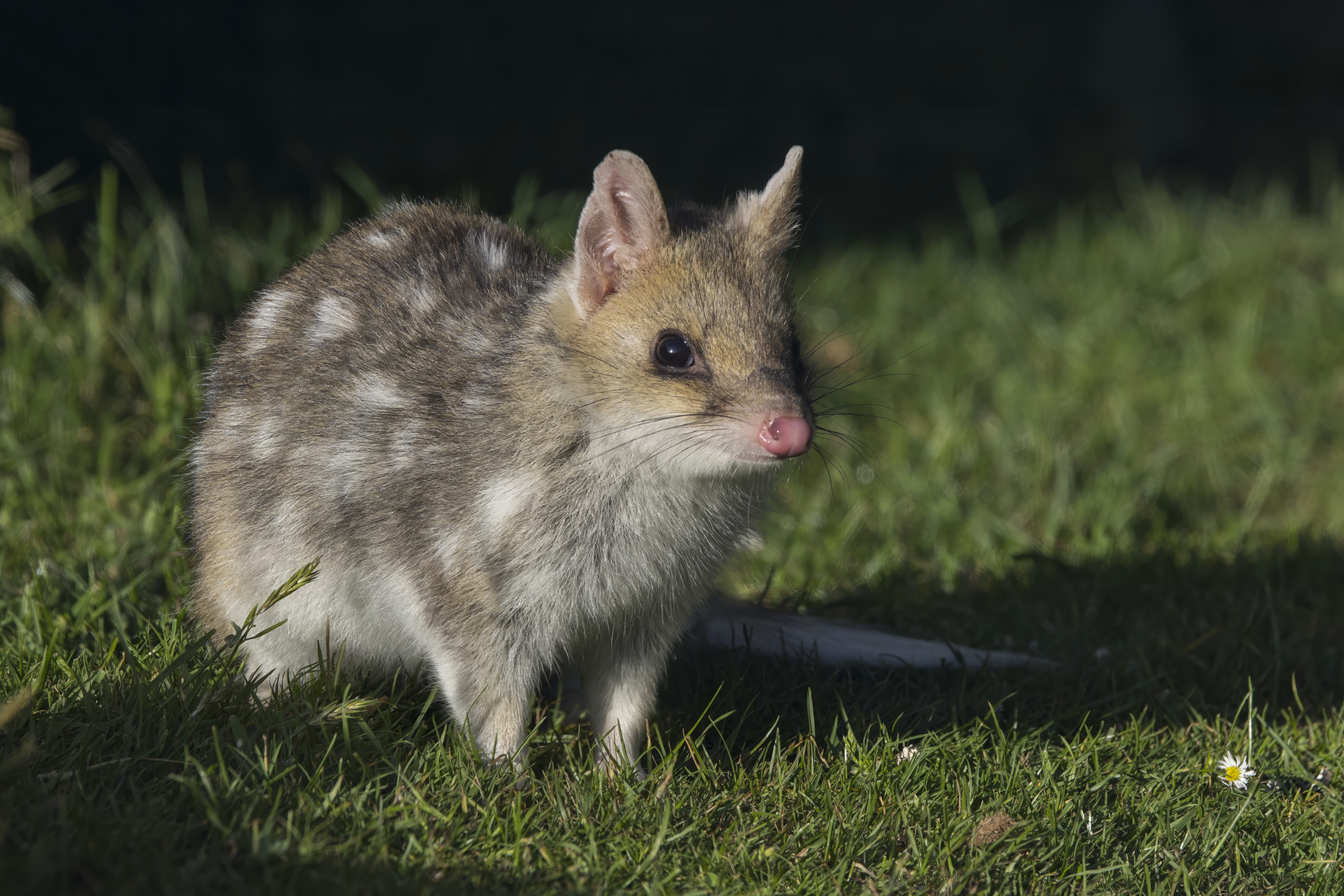
The northern quoll is a carnivorous marsupial distinguished by its spotted coat, pointed snout, and cat-sized body, with males considerably larger than females. As a nocturnal, opportunistic predator, it feeds on insects, small vertebrates, fruit, and carrion, playing a role in controlling invertebrate and small prey populations while also serving as prey for larger predators. Males typically die after their first breeding season, a semelparous strategy unusual among mammals.
The species is restricted to northern Australia, occurring in fragmented populations across Queensland, the Northern Territory, and Western Australia. It inhabits a range of environments including tropical savanna, moist lowland forest, rocky escarpments, and coastal areas, often denning in rock crevices, tree hollows, or termite mounds.
Population decline stems from several interacting pressures. Frequent, intense fire regimes reduce vegetation cover and prey availability, increasing vulnerability to predation. The spread of the invasive cane toad has caused rapid population collapses, as quolls are poisoned when attempting to eat this toxic species. Urban and agricultural expansion, including land clearing for crops, has fragmented remaining habitat, while predation by feral cats compounds these losses.
Conservation efforts include establishing insurance populations on toad-free islands, translocations to predator-free sanctuaries, targeted fire management to preserve refuge habitat, and research into conditioned taste aversion to reduce toad-related mortality. Some populations are monitored through long-term ecological surveys to track trends and inform management.
Despite these interventions, the species continues to decline across much of its mainland range, particularly where cane toads have newly arrived. Its persistence increasingly depends on isolated, actively managed populations, making its long-term outlook uncertain without sustained conservation investment.
The Northern Quoll faces ongoing pressure from land clearing for housing and urban development, along with the expansion of farmland for crops, both of which destroy and fragment its natural habitat. Frequent fires and poorly managed burning damage the bush areas it depends on for shelter and hunting, while native predators and diseases add further strain to its survival. These combined threats currently remain steady rather than showing clear signs of easing or worsening.
Habitat
Conservation measures underway
Other threatened species in DASYURIDAE
Threatened in Australia
Frequently asked questions
Why is Northern Quoll classified as Endangered?
Where does Northern Quoll live?
What are the main threats to Northern Quoll?
Get weekly conservation intelligence
One short digest a week of the most striking species and country data we ship, plus breaking conservation news paired with our database where it matters.
Free, no spam. One-click unsubscribe in every email.