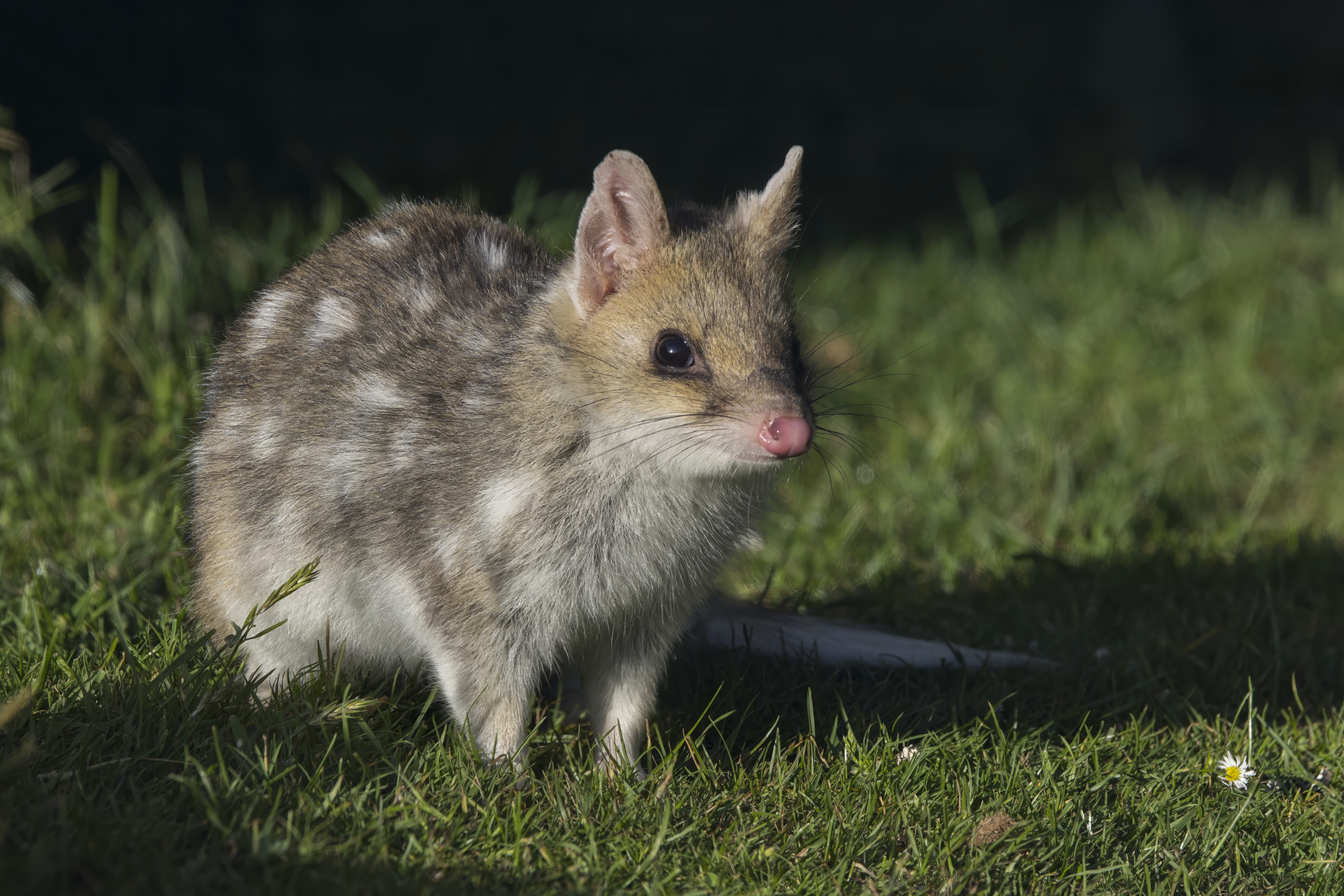
Eastern Quoll
Dasyurus viverrinus
Photo: Wikimedia Commons (CC) via https://en.wikipedia.org/wiki/Eastern_quoll
Overview
The Eastern Quoll is a carnivorous marsupial, one of six species in the genus Dasyurus within the family Dasyuridae. It has a slender body covered in brown or black fur with distinctive white spots, a pointed snout, and a long tail. Weighing around 700 grams to 2 kilograms, it is primarily nocturnal, foraging alone for insects, small mammals, birds, and fruit, while also scavenging carrion.
As a mid-level predator, it plays an important role in controlling invertebrate and small vertebrate populations and contributes to nutrient cycling through its scavenging behaviour.
Once widespread across mainland southeastern Australia, the species is now restricted to Tasmania, following its disappearance from the mainland by the mid-20th century, with some reintroduction efforts underway there. It inhabits a range of environments including forests, shrubland, grassland, and agricultural or semi-urban areas, and it uses caves and burrows for shelter.
The species faces multiple ongoing threats. Vehicle collisions on roads cause direct mortality, while historical and continuing trapping and persecution have reduced numbers. Invasive species, particularly introduced predators such as foxes and feral cats, prey on quolls and compete for food resources, and disease introduced by non-native species poses additional risk. Interactions with problematic native species also contribute to population pressure.
Conservation efforts include monitoring programs in Tasmania, predator control initiatives, and mainland reintroduction trials aimed at reestablishing populations in fenced, predator-free reserves. Captive breeding programs support these reintroduction efforts.
Despite these measures, the population trend remains decreasing, and the species is classified as Endangered. Its long-term recovery depends on sustained predator control and the success of reintroduction programs beyond Tasmania.
Eastern Quolls face ongoing dangers from being hit by vehicles on roads, being hunted or trapped, and predation or competition from introduced animals like foxes and cats. They're also affected by native species that prey on them or spread disease. These threats are currently stable and continuing rather than clearly worsening or improving.
Habitat
Conservation measures underway
Other threatened species in DASYURIDAE

Threatened in Australia
Frequently asked questions
Why is Eastern Quoll classified as Endangered?
Where does Eastern Quoll live?
What are the main threats to Eastern Quoll?
Get weekly conservation intelligence
One short digest a week of the most striking species and country data we ship, plus breaking conservation news paired with our database where it matters.
Free, no spam. One-click unsubscribe in every email.