
Northern Emerald
Somatochlora arctica
Photo: Wikimedia Commons (CC) via https://en.wikipedia.org/wiki/Northern_emerald
Overview
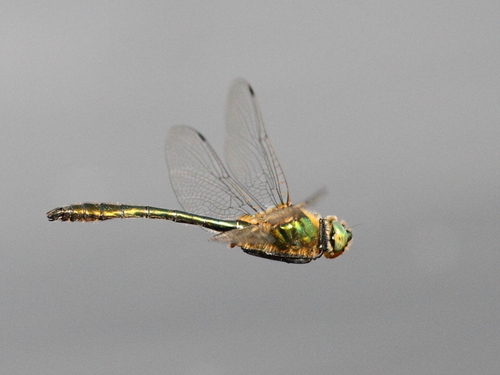
The northern emerald is a species of emerald dragonfly found in northern and middle Eurasia. The species was first described in 1840 from Scandinavia. It is a relatively small dragonfly, just 4 to 5 centimetres long, and is recognizable by its hairy thorax, dark abdomen, and bright green eyes.
The males have narrowly waisted abdomens, while the females have straight ones; the females are also recognizable by the two lateral yellow spots behind the thorax. Northern emeralds pass two years as larvae in sphagnum-rich bog pools before emerging as adults which hunt above peat bogs, wet meadows, and open woodlands. Despite being assessed as a least-concern species by the IUCN, northern emeralds are threatened by habitat loss caused by human activity, and climate change is expected to exacerbate the problem.
The northern emerald is found from Japan and the Kamchatka Peninsula through much of Russia. It is abundant throughout Fennoscandia, and is also well-known from the Alps and the Scottish Highlands. Its distribution in lowland Europe is sparse, but the dragonflies can be hard to find and record.
The Northern Emerald faces severe threats from climate change, which is altering the cold, pristine bog and fen habitats essential for its survival. Habitat degradation from peat extraction, drainage, and development activities further reduces available breeding sites, while the species' limited dispersal ability and specialized habitat requirements make population recovery extremely difficult.
Habitat
Northern Emerald dragonflies inhabit cold, acidic sphagnum bogs, fens, and shallow pools in boreal and subarctic regions. They require pristine wetland environments with slow-moving or still water, typically surrounded by sedges and mosses in areas with cool summer temperatures.
Other threatened species in Corduliidae



Threatened in Åland Islands


Frequently asked questions
Why is Northern Emerald classified as Critically Endangered?
Where does Northern Emerald live?
What are the main threats to Northern Emerald?
Get weekly conservation intelligence
One short digest a week of the most striking species and country data we ship, plus breaking conservation news paired with our database where it matters.
Free, no spam. One-click unsubscribe in every email.