Scutula effusa
Overview
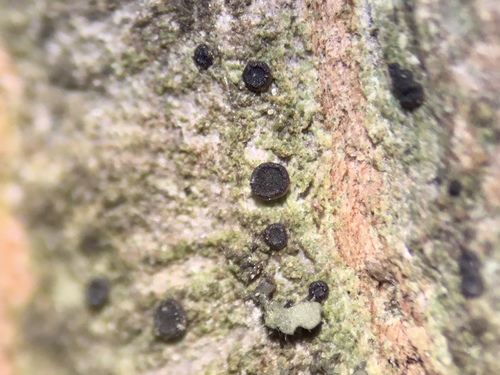
Scutula effusa is a lichenicolous fungus belonging to the family Byssolomataceae within the order Lecanorales. Like other members of this genus, it grows in close association with lichen thalli, deriving nutrients from its host and forming inconspicuous fruiting structures on the lichen surface rather than producing a free-living thallus of its own. Such fungi play a subtle but important ecological role, participating in the fine-scale ecological interactions that shape lichen communities and contributing to fungal diversity in forest ecosystems.
The species has been recorded across a broad swath of the Northern Hemisphere, including the United Kingdom, several Central and Northern European countries (France, Germany, Austria, Switzerland, Poland, Hungary, Slovakia, Czechia, Denmark, Sweden, Norway, Finland), southern Europe (Spain, Italy, Greece, Romania), Ukraine, North America (Canada, United States), and more unusually Colombia and Australia. It is confined to terrestrial habitats, typically forested environments where suitable host lichens persist.
No reliable population figures exist, and the population trend is listed as unknown, though the species is classified as Critically Endangered. Threats include air pollution and nitrogen deposition, which alter substrate chemistry and host lichen viability; habitat loss from deforestation; changing forest management practices; urbanization and development pressure; and the broader impacts of climate change on forest microhabitats.
Specific targeted conservation programs for this fungus are not documented, though it likely benefits indirectly from forest conservation, protected area management, and air quality regulations aimed at reducing nitrogen deposition in parts of its European range. Given ongoing habitat pressures and the absence of dedicated monitoring, its long-term outlook remains precarious and poorly quantified.
Scutula effusa is mainly at risk from forests being cut down and land being cleared for towns and buildings, which destroys the places it needs to survive. It's also affected by air pollution (especially nitrogen-based pollutants that change its habitat's chemistry), ongoing shifts in climate patterns, and forestry practices that alter or disturb woodland areas. These combined pressures appear to be intensifying rather than easing, as ongoing development and environmental changes continue unabated.
Habitat
Mörk lundlav grows on the bark of deciduous trees, particularly in old-growth and mature forests with high humidity and stable microclimatic conditions. It typically occurs in shaded woodland environments with minimal air pollution and established forest ecosystems.
Other threatened species in Byssolomataceae
Threatened in Australia
Frequently asked questions
Why is Scutula effusa classified as Critically Endangered?
Where does Scutula effusa live?
What are the main threats to Scutula effusa?
Get weekly conservation intelligence
One short digest a week of the most striking species and country data we ship, plus breaking conservation news paired with our database where it matters.
Free, no spam. One-click unsubscribe in every email.