
Livistona drudei
Local name: Drude’s palm
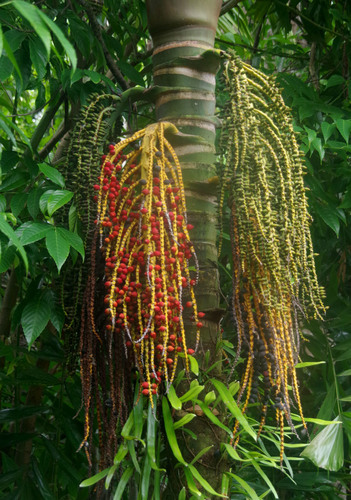
Photo: Wikimedia Commons (CC) via https://en.wikipedia.org/wiki/Livistona_drudei
Overview
Livistona drudei is a solitary-trunked fan palm reaching heights of up to 15–20 meters, with a slender gray trunk topped by a crown of large, deeply divided, fan-shaped leaves. Like other members of the Arecaceae family, it produces small flowers on branched inflorescences that develop into rounded fruits, which are consumed and dispersed by birds and other fauna. Within its forest habitat, the species contributes structural diversity to the canopy and midstory, and its fruit provides a seasonal food resource for local wildlife.
The species occurs in Australia, particularly in tropical woodland and forest habitats of northern Queensland, and has also been recorded in China. It typically grows along watercourses, in seasonally moist depressions, or on forest margins where sufficient light reaches the understory.
Livistona drudei is classified as Endangered, with population trend unknown. Its decline is driven by ongoing habitat loss from residential and commercial development, agricultural expansion and intensification, and infrastructure projects that fragment or clear its native forest habitat. Altered fire regimes, including increased fire frequency or intensity linked to land-use change, damage seedlings and mature individuals alike.
Competition from invasive plant species further degrades remaining habitat by outcompeting native vegetation and altering understory conditions necessary for regeneration.
Conservation efforts include habitat protection within existing reserves and protected forest areas, along with broader regional strategies targeting invasive species control and fire management in tropical Australian ecosystems. Monitoring of remaining populations continues, though comprehensive range-wide population data remain limited.
Given the continued and unmitigated pressure from land conversion, altered fire patterns, and invasive competition, the species faces ongoing habitat degradation. Without expanded protective measures, its long-term conservation status is likely to remain precarious.
Drude's palm faces ongoing pressure from land being cleared and built on for housing, businesses, and roads, as well as land being converted or used more intensively for farming. Changes in how often and how intensely fires burn through its habitat, along with competition from invasive plants crowding out the palm, add further strain. These threats are currently stable but ongoing, with no signs of easing.
Habitat
This palm species inhabits coastal lowland areas and adjacent foothills in northeastern Queensland, typically growing in sandy soils near creek lines and in open woodland margins. It occurs in transitional zones between rainforest and more open eucalyptus woodland communities.
Other threatened species in ARECACEAE
Threatened in Australia
Frequently asked questions
Why is Drude’s palm classified as Endangered?
Where does Drude’s palm live?
What are the main threats to Drude’s palm?
Get weekly conservation intelligence
One short digest a week of the most striking species and country data we ship, plus breaking conservation news paired with our database where it matters.
Free, no spam. One-click unsubscribe in every email.