Kawanaphila pachomai
Overview
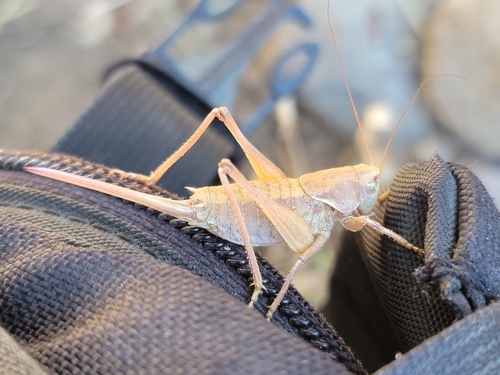
Kawanaphila pachomai is a katydid belonging to the family Tettigoniidae, a group of insects known for their long antennae, stridulating males, and specialized hind legs adapted for jumping. Like other members of its genus, it is likely associated with heathland vegetation, feeding on plant material and possibly pollen or flower parts, while serving as a food source for birds, reptiles, and other insectivorous predators within its ecosystem. Males of related Kawanaphila species produce calling songs to attract mates, a behaviour typical of the family.
This species is endemic to Australia, where it occupies terrestrial habitats, most likely restricted heathland or shrubland environments characteristic of the genus. Its known range appears to be narrow, consistent with its classification as Endangered and its documented small population size.
The species faces multiple concurrent threats. Agricultural expansion and intensification are reducing and degrading native vegetation, while urban and commercial development further fragments remaining habitat. Ongoing forest fragmentation compounds these pressures by isolating populations into smaller, more vulnerable patches.
Climate change and associated weather extremes threaten to alter habitat suitability and disrupt life cycles, while the species' inherently restricted range and small population size increase its vulnerability to stochastic events and localized disturbances.
Specific conservation programs targeting Kawanaphila pachomai are not well documented, though broader habitat protection efforts in Australia, including reserve management and native vegetation conservation policies, may offer indirect benefit. Population trends remain unknown due to limited monitoring data.
Given the combination of ongoing habitat loss, climate pressures, and a restricted range, the species' long-term outlook remains uncertain, and continued habitat protection and population monitoring would be necessary to clarify its conservation trajectory.
Kawanaphila pachomai is losing its natural habitat as land is cleared for farming and expanded for towns and buildings, while the remaining wild areas become increasingly broken up and isolated. It also faces added pressure from shifting weather patterns and rising temperatures linked to climate change, which is especially risky since the species already exists in small numbers within a limited area. Overall, these combined pressures appear to be ongoing and intensifying rather than easing.
Habitat
This endemic cricket species inhabits moist tropical forests and forest edges in the Philippines, requiring specific microhabitat conditions including adequate moisture levels and forest canopy cover. The species appears to be restricted to primary and secondary forest environments with dense vegetation structure.
Other threatened species in TETTIGONIIDAE
Threatened in Australia
Frequently asked questions
Why is Kawanaphila pachomai classified as Endangered?
Where does Kawanaphila pachomai live?
What are the main threats to Kawanaphila pachomai?
Get weekly conservation intelligence
One short digest a week of the most striking species and country data we ship, plus breaking conservation news paired with our database where it matters.
Free, no spam. One-click unsubscribe in every email.