Great Hornbill
Buceros bicornis
Overview
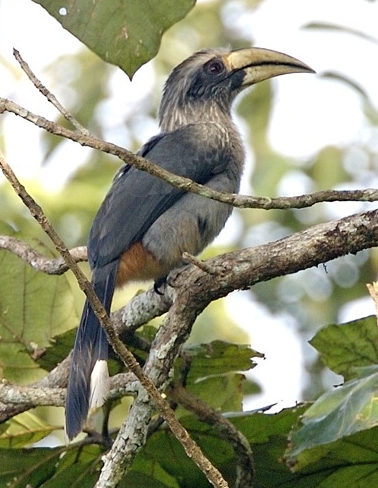
The Great Hornbill is one of Asia's largest birds, measuring up to 120 cm in length with a distinctive wingspan reaching 180 cm. Males are characterized by their prominent yellow and black casque—a hollow structure atop their massive bill—while females have smaller casques. These birds are primarily frugivorous, playing a crucial role as seed dispersers for large-fruited trees in tropical forests.
Their loud, resonant calls can be heard over considerable distances, serving important communication functions within their territories.
Great Hornbills inhabit subtropical and tropical moist lowland forests across South and Southeast Asia, ranging from the foothills of the Himalayas through Myanmar, Thailand, Malaysia, and parts of Indonesia. They require large, mature trees for nesting, particularly those with suitable cavities where females seal themselves during the breeding season.
The species faces mounting pressure from habitat destruction driven by agricultural expansion and logging operations that remove the large trees essential for nesting. Urban development fragments their forest habitat, while hunting poses a significant threat—hornbills are targeted for their casques, which are valued in traditional medicine and as decorative items. Illegal wildlife trade continues despite protective legislation.
Conservation efforts include habitat protection through national parks and reserves across their range, anti-poaching initiatives, and community-based conservation programs. Several countries have implemented stricter enforcement of wildlife protection laws.
With populations continuing to decline and habitat loss accelerating, the Great Hornbill's outlook remains concerning. Success depends on maintaining large forest corridors and reducing hunting pressure across their fragmented range.
The Great Hornbill faces serious threats from the clearing of forests for cities, towns, and farmland growing crops like palm oil and rubber, which destroys the large old trees these birds need for nesting. People also hunt and trap these distinctive birds for their meat, feathers, and large colorful beaks, while logging operations remove the mature forest trees that hornbills depend on for food and shelter. All of these threats are currently ongoing and appear to be continuing at similar levels.
Habitat
Conservation measures underway
Other threatened species in BUCEROTIDAE


Threatened in Bangladesh



Frequently asked questions
Why is Great Hornbill classified as Vulnerable?
Where does Great Hornbill live?
What are the main threats to Great Hornbill?
Get weekly conservation intelligence
One short digest a week of the most striking species and country data we ship, plus breaking conservation news paired with our database where it matters.
Free, no spam. One-click unsubscribe in every email.