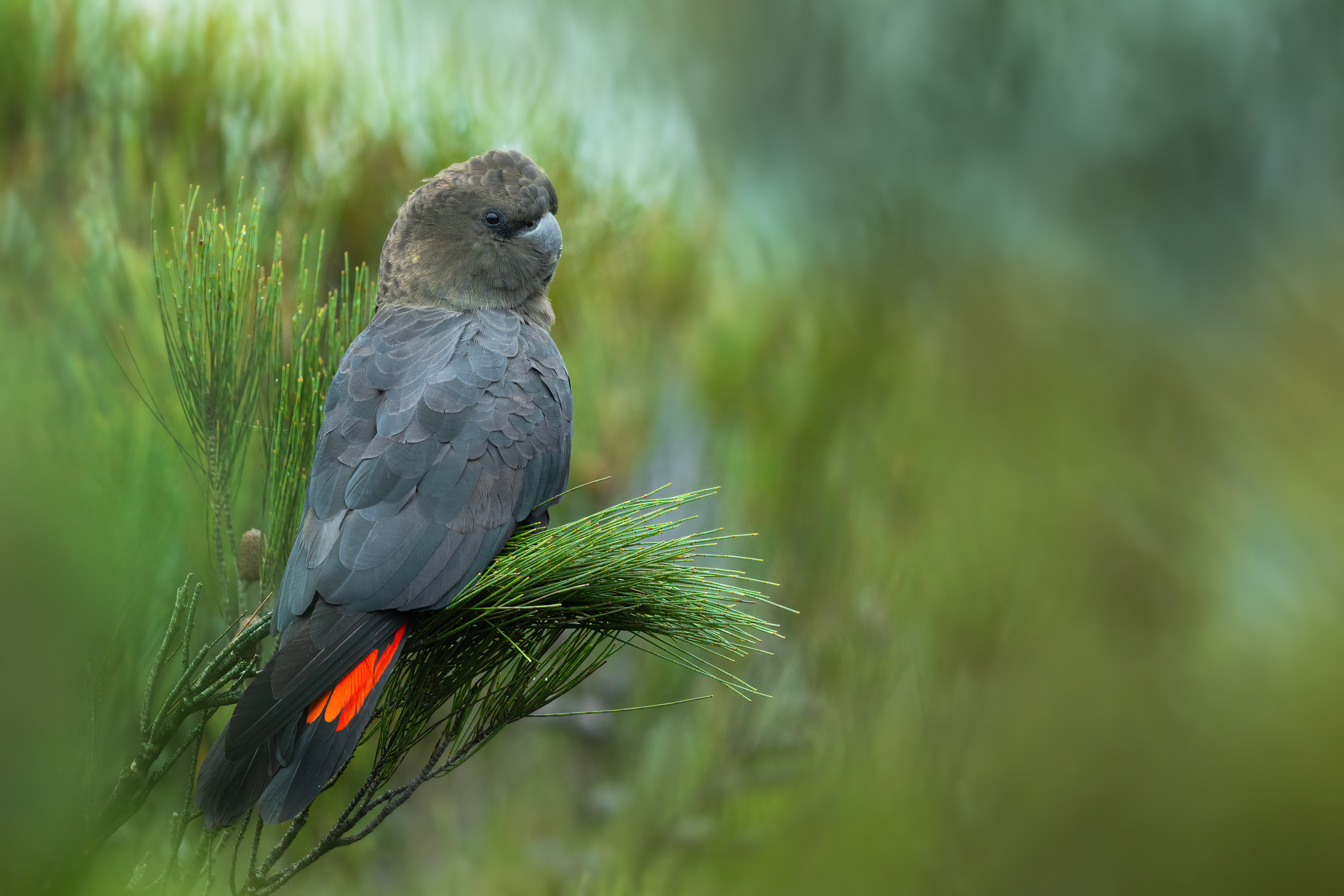
Glossy Black-cockatoo
Calyptorhynchus lathami
Photo: Wikimedia Commons (CC) via https://en.wikipedia.org/wiki/Glossy_black_cockatoo
Overview
Calyptorhynchus lathami is a large cockatoo distinguished by its dark brownish-black plumage, with males and females both showing distinctive red or orange-red panels in the tail feathers, more mottled in females. It has a distinctively large bill adapted for cracking open the woody seed cones of casuarina and allocasuarina trees, which form the overwhelming majority of its diet. The species is typically observed in pairs or small family groups, feeding quietly in the canopy, and plays an important ecological role in seed dispersal and as an indicator of the health of casuarina woodlands.
The species is endemic to eastern Australia, ranging from central Queensland through New South Wales and into Victoria, with a genetically distinct population on Kangaroo Island in South Australia. It inhabits open forests and woodlands dominated by she-oak species, relying on mature trees for both feeding and nesting hollows.
Threats include ongoing habitat loss from urban expansion and agricultural land conversion, which reduce the availability of casuarina feeding trees and hollow-bearing nest trees. Altered fire regimes and increasingly severe bushfires have destroyed significant tracts of feeding habitat, compounded by drought stress on remaining vegetation. Competition for nest hollows from other native species, and predation, particularly by introduced species, further limit breeding success.
Conservation actions include installation of artificial nest boxes, protection and restoration of casuarina habitat, feral predator control programs, and monitoring of breeding populations, particularly on Kangaroo Island following major bushfire losses. Population trends remain in decline across most of the range. Without sustained habitat protection and fire management, the species is likely to continue facing pressure, though targeted regional conservation programs have shown localized benefits for breeding success.
The Glossy Black-cockatoo faces mounting pressure as land is cleared for housing developments and livestock grazing, destroying the woodlands it depends on for food and nesting hollows. Invasive species and competing native animals add further strain, while worsening droughts and bushfires—intensified by climate change—destroy feeding trees and nesting sites. Overall, these combined threats appear to be intensifying, particularly due to more frequent and severe fire and drought events.
Conservation measures underway
Other threatened species in CACATUIDAE


Threatened in Australia
Frequently asked questions
Why is Glossy Black-cockatoo classified as Vulnerable?
Where does Glossy Black-cockatoo live?
What are the main threats to Glossy Black-cockatoo?
Get weekly conservation intelligence
One short digest a week of the most striking species and country data we ship, plus breaking conservation news paired with our database where it matters.
Free, no spam. One-click unsubscribe in every email.