Foxtail Stonewort
Lamprothamnium papulosum
Overview
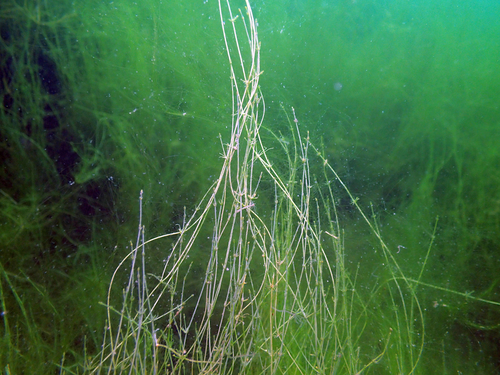
Lamprothamnium papulosum is a macroalga in the stonewort family, belonging to a group of charophyte algae that superficially resemble vascular plants but reproduce and grow in ways characteristic of green algae. It forms branched, whorled structures anchored in sediment, with a bushy, fox-tail-like appearance that gives it its common name. As a photosynthetic organism, it contributes to oxygenation and structural complexity in the shallow, still or slow-moving waters it inhabits, offering shelter for invertebrates and helping stabilize fine sediments.
The species occupies brackish coastal habitats such as lagoons, saline pools, and estuarine margins, and has been recorded across a wide but fragmented range spanning Europe, North Africa, the Middle East, southern Africa, and Australasia, including France, the United Kingdom, Sweden, Spain, Denmark, Norway, Ireland, the Netherlands, Germany, Italy, Portugal, Greece, Cyprus, Ukraine, Montenegro, Morocco, Algeria, Iran, South Africa, Australia, and New Zealand.
Its populations are declining due to coastal development that destroys or fragments lagoon habitats, nutrient pollution and eutrophication that alter water chemistry, increased sedimentation and turbidity that reduce light penetration, sea level rise and shifting salinity linked to climate change, and physical disturbance from recreational use of coastal waters.
Conservation measures include site-based habitat protections within some coastal and wetland reserves, monitoring of lagoon water quality, and inclusion of the species in regional red lists and conservation assessments that inform land-use planning. No large-scale captive propagation or reintroduction programs are documented.
Population trends remain unknown due to limited monitoring, but the combination of ongoing habitat pressures across its fragmented range suggests continued vulnerability, warranting sustained site protection and further population surveys.
Foxtail Stonewort, a type of algae that grows in coastal lagoons and salty ponds, is under pressure as coastal building projects destroy or shrink its watery homes, while runoff carrying fertilizers and waste causes excess algae and murky conditions that block the light it needs. Rising seas linked to climate change, along with mud and silt clouding the water, further degrade its habitat, and activities like boating, wading, or dredging in these shallow waters cause physical damage. These combined pressures appear to be intensifying rather than easing, as coastal development and climate-related changes continue to grow.
Habitat
Foxtail Stonewort inhabits shallow brackish lagoons, coastal pools, and sheltered estuarine waters with moderate salinity levels. It typically grows in sandy or muddy substrates in waters 0.5-3 meters deep where salinity fluctuates between fresh and marine conditions.
Other threatened species in Characeae


Threatened in Algeria


Frequently asked questions
Why is Foxtail Stonewort classified as Endangered?
Where does Foxtail Stonewort live?
What are the main threats to Foxtail Stonewort?
Get weekly conservation intelligence
One short digest a week of the most striking species and country data we ship, plus breaking conservation news paired with our database where it matters.
Free, no spam. One-click unsubscribe in every email.