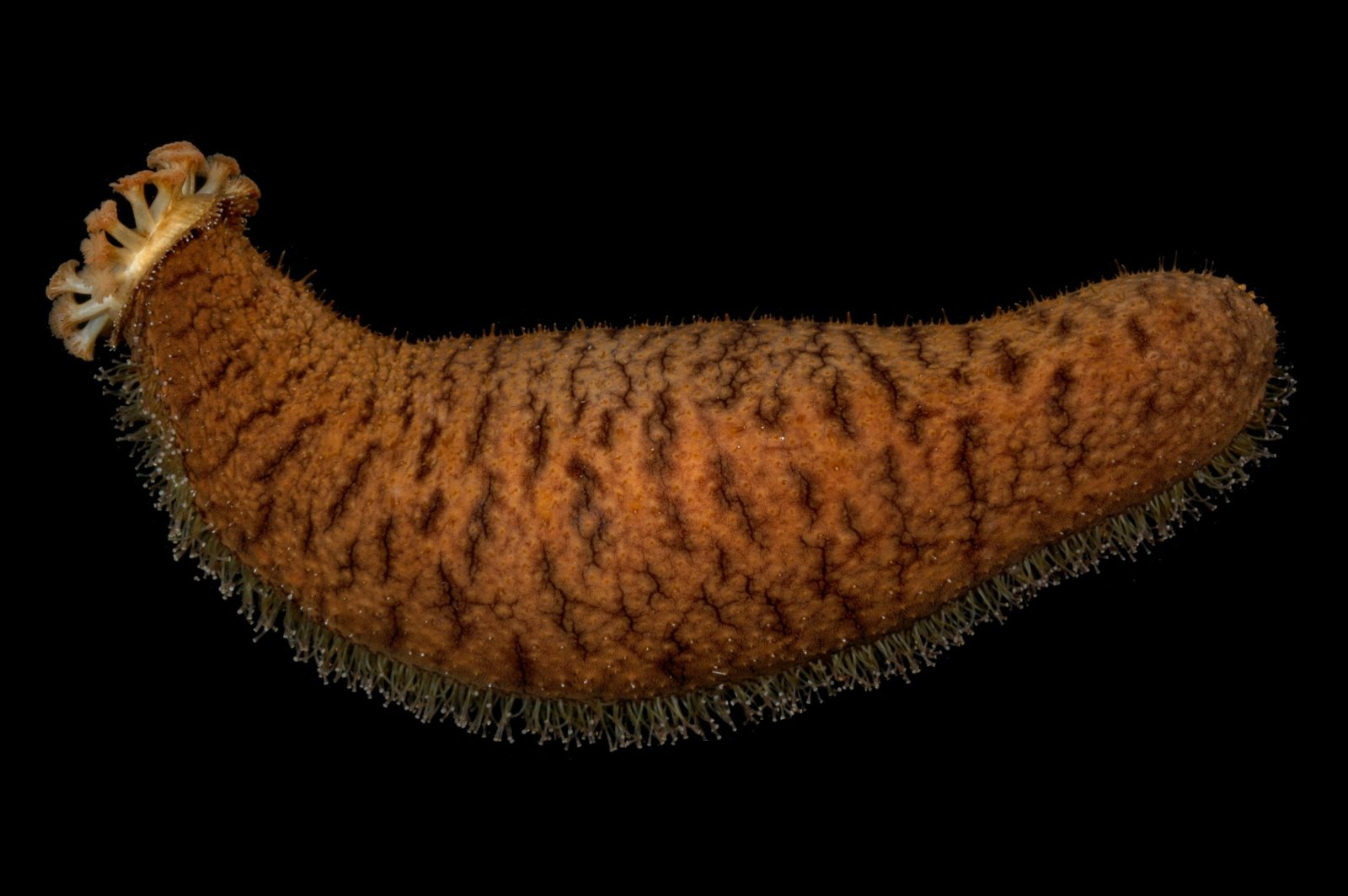
Actinopyga echinites
Photo: Wikimedia Commons (CC) via https://en.wikipedia.org/wiki/Actinopyga_echinites
Overview
Actinopyga echinites, commonly known as the deepwater redfish or tigerfish sea cucumber, is a large-bodied sea cucumber in the family Holothuriidae. It has a thick, firm body wall typically dark brown to black in color, with a somewhat rectangular cross-section when viewed from above. Like other holothurians, it feeds by ingesting sediment and organic detritus, extracting nutrients as it passes material through its digestive tract.
This deposit-feeding behavior aerates and recycles seafloor sediments, making the species an important contributor to nutrient cycling in shallow marine ecosystems.
The species occupies shallow marine and coastal habitats, including reef flats, rocky areas, sandy substrates, and neritic waters, generally in the intertidal to shallow subtidal zone. Its range spans the Indo-Pacific and western Indian Ocean, with records from dozens of countries and territories including Australia, Madagascar, the Philippines, Indonesia, Papua New Guinea, Fiji, and numerous Pacific island nations.
The primary threat to Actinopyga echinites is direct harvesting for the bêche-de-mer (dried sea cucumber) trade, which targets it for food markets, particularly in Asia. Its relatively large size, accessibility in shallow water, and market value make it a preferred target, leading to localized depletion across much of its range. Overfishing has reduced populations in many areas, and the species is classified as Vulnerable with a decreasing population trend.
Conservation measures include fishing bans, quotas, and size limits implemented in several Pacific and Indian Ocean nations, along with monitoring under CITES discussions for sea cucumber trade regulation. Enforcement remains inconsistent across its wide range. Without stronger, consistently applied harvest controls, continued demand is likely to sustain population declines in unmanaged or poorly regulated fisheries.
The main danger to this sea cucumber species is people collecting and harvesting them from the ocean, often for use in food markets, and this is an ongoing activity. This kind of direct removal from the wild can reduce their numbers faster than they can reproduce and recover. Based on the continued nature of this harvesting, the threat appears to be stable to ongoing rather than clearly decreasing.
Habitat
Conservation measures underway
Other threatened species in HOLOTHURIIDAE
Threatened in Australia
Frequently asked questions
Why is Actinopyga echinites classified as Vulnerable?
Where does Actinopyga echinites live?
What are the main threats to Actinopyga echinites?
Get weekly conservation intelligence
One short digest a week of the most striking species and country data we ship, plus breaking conservation news paired with our database where it matters.
Free, no spam. One-click unsubscribe in every email.