Actinopyga miliaris
Overview
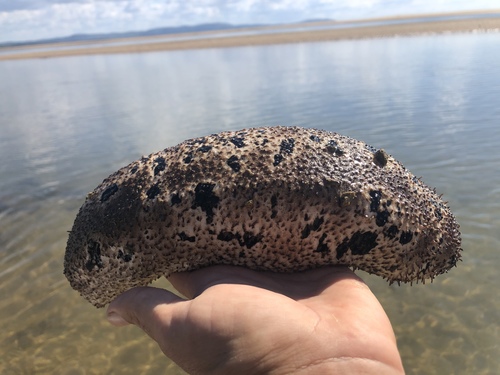
Actinopyga miliaris is a large sea cucumber in the family Holothuriidae, recognized by its thick, black to dark brown body wall, robust cylindrical shape, and rows of prominent papillae along its upper surface. Like other holothurians, it moves slowly across the substrate using tube feet, feeding on organic detritus and sediment, which it processes and deposits as cleaned sand. This bioturbation activity recycles nutrients and helps maintain the health of benthic marine environments, making the species an important contributor to sediment turnover and nutrient cycling in the ecosystems it inhabits.
The species has a wide Indo-Pacific distribution, with recorded populations in Australia, Tuvalu, Fiji, Japan, China, India, and reported occurrences in the United States. It occupies marine neritic and coastal/supratidal zones, typically in shallow lagoons, reef flats, and sandy or rubble substrates, and has also been associated with permanent inland freshwater habitats in some regions.
Actinopyga miliaris is classified as Vulnerable, with a decreasing population trend. The principal threat is direct harvesting for the commercial sea cucumber (bêche-de-mer) trade, which targets this species intensively due to high market demand. Overfishing has reduced local densities in many areas, and slow growth and reproduction rates limit the species' ability to recover from sustained harvest pressure.
Conservation responses include fishery regulations, catch quotas, size limits, and seasonal or area closures implemented in several range states, along with monitoring efforts to track population status. Enforcement and management effectiveness vary considerably by country. Without stronger, consistently applied harvest controls, continued exploitation is likely to sustain population declines across much of its range.
The main threat to this sea cucumber species is ongoing overharvesting by people collecting them from the ocean, primarily for food and commercial trade. This continuous fishing pressure can reduce their numbers faster than populations can recover. This threat remains ongoing and stable, with no indication of it decreasing.
Habitat
Conservation measures underway
Other threatened species in HOLOTHURIIDAE
Threatened in Australia
Frequently asked questions
Why is Actinopyga miliaris classified as Vulnerable?
Where does Actinopyga miliaris live?
What are the main threats to Actinopyga miliaris?
Get weekly conservation intelligence
One short digest a week of the most striking species and country data we ship, plus breaking conservation news paired with our database where it matters.
Free, no spam. One-click unsubscribe in every email.