Colletid bee
CRCritically Endangered

Colletid bee

Hylaeus pictipes

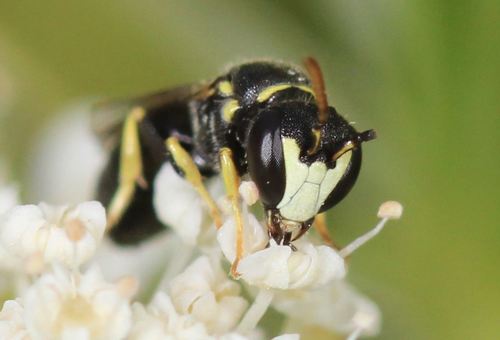
Hylaeus pictipes is a small, black colletid bee with distinctive yellow markings on the face and legs, belonging to the masked bee group. These solitary bees are important pollinators of native flowering plants, with females constructing brood cells lined with a cellophane-like secretion in hollow stems or small cavities.

26

Countries

Photo: iNaturalist: (c) jgibbs, some rights reserved (CC BY-NC), uploaded by jgibbs

01Classification

Taxonomy & Classification

Kingdom

Animalia

Phylum

Arthropoda

Class

Insecta

Order

Hymenoptera

Family

Colletidae

Genus

Hylaeus

Colletid bee belongs to the family Colletidae, order Hymenoptera, within the Insecta class.

02Description

Species Profile

Hylaeus pictipes is a small, black colletid bee with distinctive yellow markings on the face and legs, belonging to the masked bee group. These solitary bees are important pollinators of native flowering plants, with females constructing brood cells lined with a cellophane-like secretion in hollow stems or small cavities. As specialized native pollinators, they play a crucial role in maintaining plant community diversity and reproductive success of their host flora.

Hylaeus pictipes, the yellow-faced bumble bee, faces severe population declines primarily due to habitat loss from urban development and agricultural intensification in its native Hawaiian range. The species is also threatened by invasive plant species that alter native ecosystems and competition from introduced bee species that may outcompete it for limited floral resources.

Key Facts

IUCN StatusCritically Endangered (CR)
GroupInsects
03Habitat

Habitat & Distribution

Hylaeus pictipes inhabits coastal dune systems, native grasslands, and open woodlands where they depend on specific native flowering plants for nectar and pollen. They require areas with suitable nesting substrates such as hollow plant stems, beetle borings in dead wood, or small natural cavities in sandy banks or cliff faces.

04Threats

Threats

!

IUCN Red List: Critically Endangered

Hylaeus pictipes, the yellow-faced bumble bee, faces severe population declines primarily due to habitat loss from urban development and agricultural intensification in its native Hawaiian range. The species is also threatened by invasive plant species that alter native ecosystems and competition from introduced bee species that may outcompete it for limited floral resources.

Agricultural intensification and land conversion

HighOngoing

Habitat loss and fragmentation from urban development

HighOngoing

Invasive plant species altering native plant communities

HighOngoing

Climate change affecting native plant phenology

MediumOngoing

Competition from introduced bee species

MediumOngoing
07National Status

National vs Global Threat Status

How this species is assessed at the national level compared to its IUCN global status (CR).

CountryNational StatusGlobal StatusComparison
EULCLeast ConcernCRCritically EndangeredLower local risk

National Red List data sourced from the National Red List Project (nationalredlist.org, ZSL) and country-specific Red List authorities.

Community

Community Sightings

Report a sighting

No community sightings yet. Be the first to report!

07Sources

Sources & Attribution

How to Cite

IUCN: IUCN (2025). The IUCN Red List of Threatened Species. Version 2025-1. Available at: https://www.iucnredlist.org. doi:10.2305/IUCN.UK.2025-1.RLTS

GBIF: GBIF.org (2025). GBIF Home Page. Available at: https://www.gbif.org

National Red Lists: ZSL (2025). National Red List. Zoological Society of London. Available at: https://www.nationalredlist.org

This page: SpeciesRadar (2025). Colletid bee (Hylaeus pictipes). SpeciesRadar: Intelligence for Earth's Biodiversity. Available at: https://speciesradar.org/species/colletid-bee

Full citation guide & data usage terms