
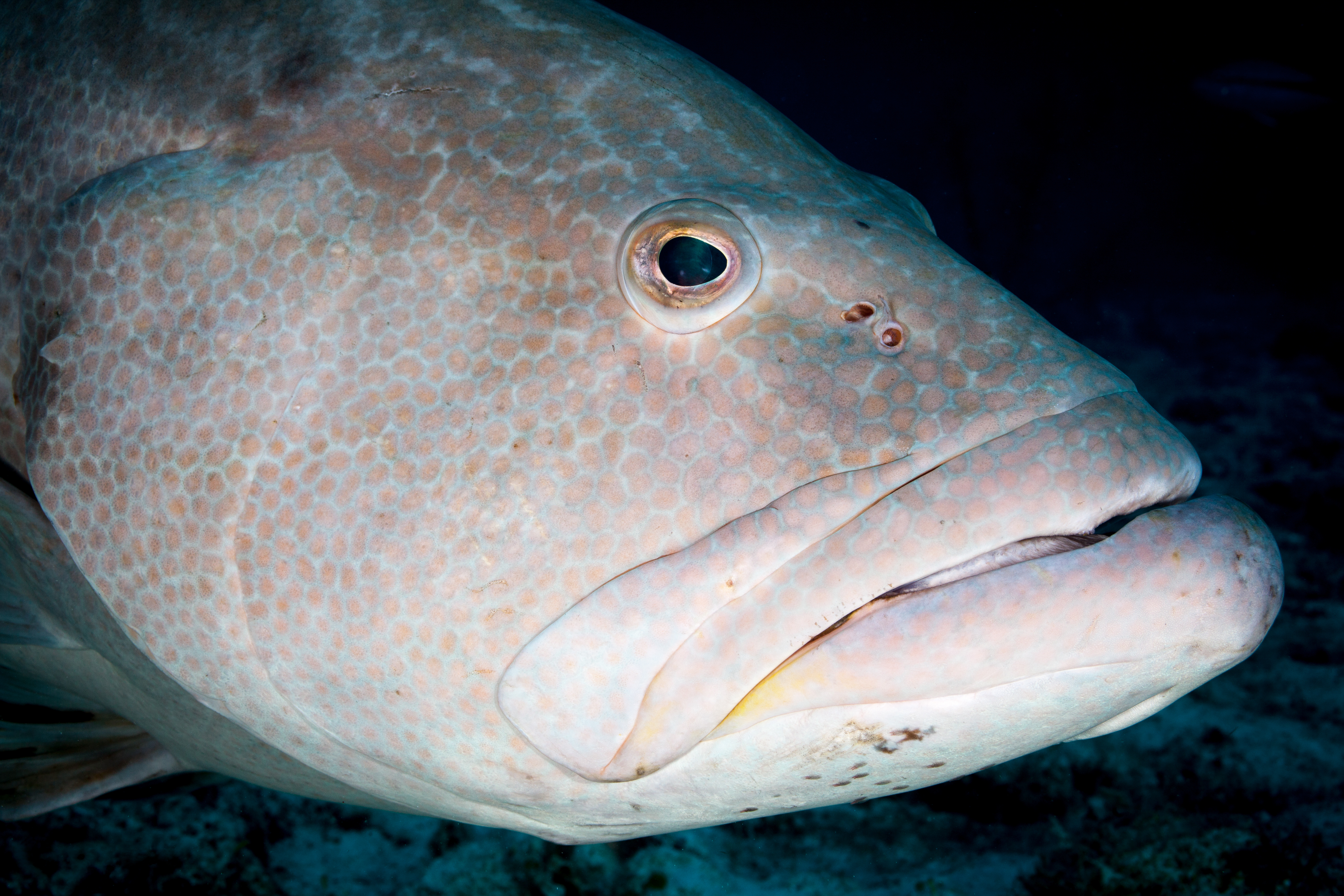
Black grouper
Mycteroperca bonaci
Photo: Wikimedia Commons (CC) via https://en.wikipedia.org/wiki/Mycteroperca_bonaci
Overview
Mycteroperca bonaci is a large reef-associated fish capable of exceeding 1.5 meters in length and reaching substantial body mass, with coloration ranging from dark mottled gray-brown to nearly black, marked by irregular blotches and worm-like markings that become more pronounced with age. As an apex or near-apex predator on reef systems, it feeds primarily on fish, cephalopods, and crustaceans, playing an important role in regulating prey populations and maintaining reef food web structure. Individuals are protogynous hermaphrodites, typically maturing first as females before some transition to males, and they form large spawning aggregations at predictable sites and times, a behavior that makes them especially vulnerable to targeted fishing.
The species occurs throughout the western Atlantic, Caribbean Sea, and Gulf of Mexico, ranging from the southeastern United States and Bermuda through Mexico, Central America, and the Caribbean island nations to Brazil, with additional records from locations such as the Seychelles and Egypt. It inhabits coral reefs, rocky bottoms, and mangrove-associated waters, with juveniles often using nearshore and estuarine habitats before moving to deeper reef environments as adults.
Population decline is driven by sustained overfishing, including commercial and recreational targeting of spawning aggregations where large numbers of reproductively active adults can be removed quickly. Slow growth, late sexual maturity, and sex-change biology limit recovery potential. Coral reef degradation and climate-related changes to reef ecosystems further reduce available habitat and prey.
Conservation responses include seasonal fishing closures during spawning periods, size and bag limits in parts of its range, and marine protected areas covering some reef habitats. Enforcement and monitoring remain inconsistent across countries. Given continued exploitation pressure and habitat decline, the species' long-term trajectory remains uncertain, with population trends currently unknown.
Black grouper are being caught faster than they can reproduce, which is especially harmful since these fish grow slowly and take years to reach breeding age. They're also losing the healthy coral reefs they depend on for food and shelter, and the specific locations where they gather to spawn are being disturbed, making it harder for the population to reproduce successfully. Warming oceans are adding further stress by damaging the coral reef ecosystems they call home. Overall, these threats appear to be ongoing and steady rather than clearly worsening or improving.
Habitat
Black grouper inhabit coral reefs, rocky bottoms, and reef drop-offs in tropical and subtropical waters of the western Atlantic, typically found at depths ranging from 10 to 100 meters. Adults prefer deeper reef areas and rocky ledges, while juveniles often utilize shallow coral reef environments and seagrass beds as nursery habitat.
Other threatened species in Serranidae

Threatened in Aruba


Frequently asked questions
Why is Black grouper classified as Vulnerable?
Where does Black grouper live?
What are the main threats to Black grouper?
Get weekly conservation intelligence
One short digest a week of the most striking species and country data we ship, plus breaking conservation news paired with our database where it matters.
Free, no spam. One-click unsubscribe in every email.