
Blue Crab
Callinectes sapidus
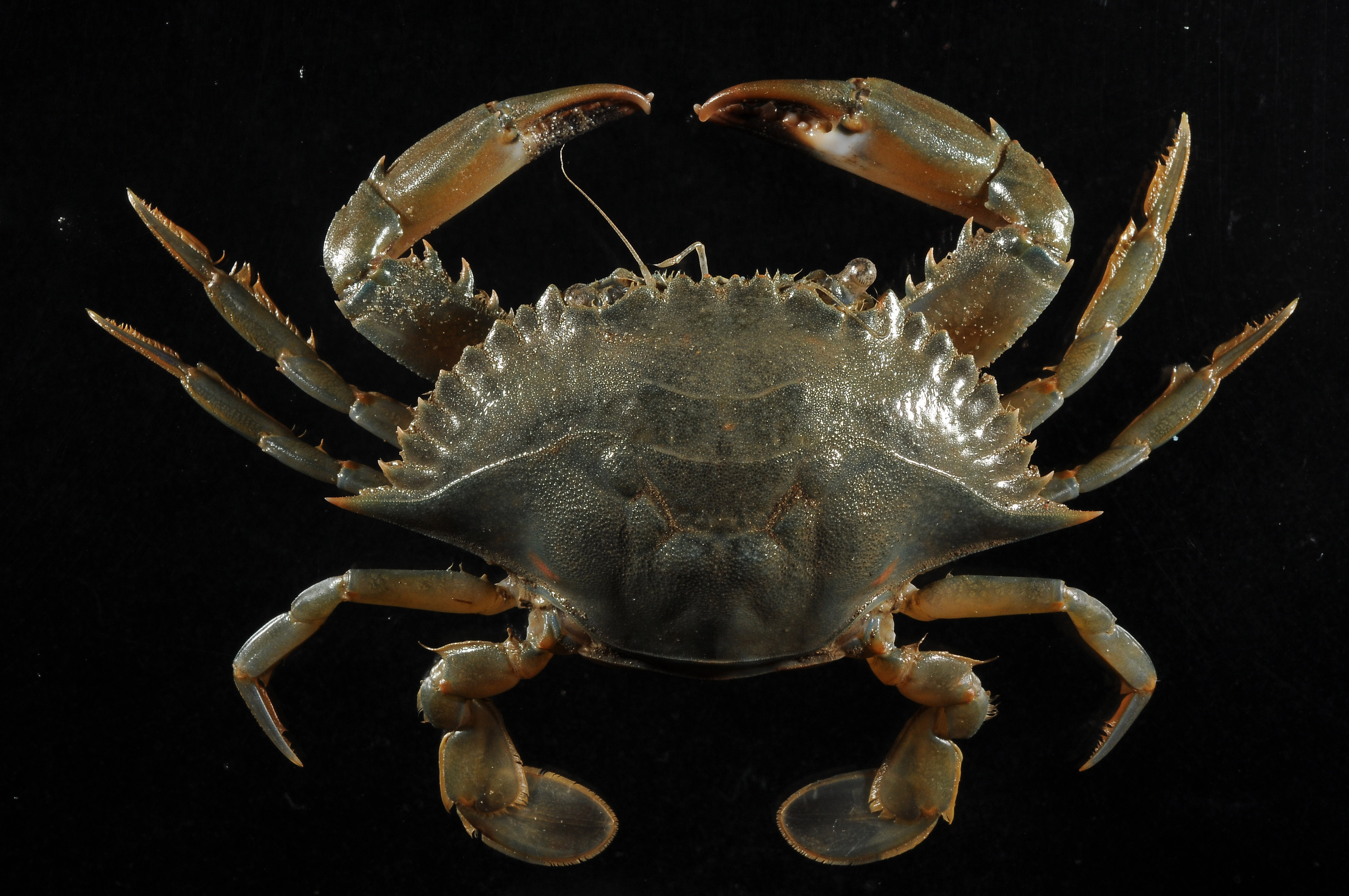
Photo: Wikimedia Commons (CC) via https://en.wikipedia.org/wiki/Callinectes_sapidus
Overview
Callinectes sapidus is a swimming crab distinguished by its blue-tinged claws, olive-to-bronze carapace, and paddle-shaped rear legs adapted for propulsion through water. As an omnivorous scavenger and predator, it feeds on mollusks, small fish, plant matter, and detritus, making it an important link between benthic food sources and higher predators such as fish, birds, and marine mammals. Highly mobile and tolerant of varying salinity, individuals migrate seasonally between estuarine and marine waters to spawn, molt, and forage.
The species occupies estuaries, coastal lagoons, seagrass beds, and nearshore marine waters, with occasional forays into freshwater tributaries. Native to the western Atlantic from the northeastern United States through the Gulf of Mexico to Uruguay and Argentina, it has also established populations in Europe, North Africa, and parts of Asia and Oceania through ballast water transport and range expansion, with confirmed occurrences across a wide span of Atlantic, Mediterranean, and Black Sea coastal nations.
Population declines are linked to sustained commercial and recreational harvest pressure, particularly in core U.S. fisheries. Coastal development has reduced nursery habitat such as marshes and seagrass beds, while agricultural runoff and nutrient pollution contribute to algal blooms and hypoxic dead zones that render portions of estuarine habitat uninhabitable.
Rising temperatures and shifting salinity patterns driven by climate change are altering migration timing and reproductive success.
Management responses include size and catch limits, seasonal harvest closures, sanctuary zones for spawning females, and habitat restoration projects targeting seagrass and wetland systems in major estuaries. Water quality monitoring programs aim to reduce nutrient loading contributing to hypoxia.
Population trends remain unquantified at a global scale, and the species' broad range and reproductive capacity provide some resilience. However, continued habitat degradation and harvest pressure in key population centers warrant ongoing monitoring.
Blue Crabs face heavy fishing pressure alongside the loss of coastal habitats to construction and development, plus pollution from farm runoff washing into their waters. Rising temperatures and changing salt levels from climate change, along with low-oxygen "dead zones" in the water, are further shrinking the places where these crabs can safely live and reproduce. Overall, these pressures appear to be ongoing and intensifying rather than easing.
Habitat
Blue crabs inhabit estuarine and coastal marine environments from Nova Scotia to Argentina, preferring brackish waters with muddy or sandy bottoms. They require access to both shallow seagrass beds for juvenile development and deeper waters for adult feeding and reproduction.
Other threatened species in Portunidae
Threatened in Albania

Frequently asked questions
Why is Blue Crab classified as Vulnerable?
Where does Blue Crab live?
What are the main threats to Blue Crab?
Get weekly conservation intelligence
One short digest a week of the most striking species and country data we ship, plus breaking conservation news paired with our database where it matters.
Free, no spam. One-click unsubscribe in every email.