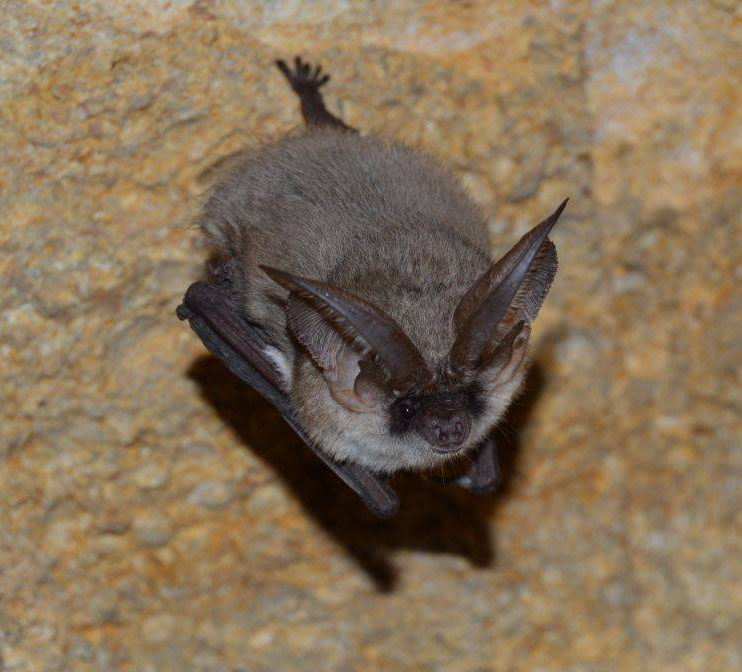
Bechstein's Bat
ENEndangered

Bechstein's Bat

Myotis bechsteinii

Bechstein's bat is a species of vesper bat found in Europe and western Asia, living in extensive areas of woodland.

Photo: Wikimedia Commons (CC) via https://en.wikipedia.org/wiki/Bechstein's_bat

01Classification

Taxonomy & Classification

Kingdom

Animalia

Phylum

Chordata

Class

Mammalia

Order

Chiroptera

Family

Vespertilionidae

Genus

Myotis

Bechstein's Bat belongs to the family Vespertilionidae, order Chiroptera, within the Mammalia class.

02Description

Species Profile

Bechstein's bat is a species of vesper bat found in Europe and western Asia, living in extensive areas of woodland.

Bechstein's Bat faces severe population declines primarily due to the loss and fragmentation of old-growth deciduous forests, which provide essential roosting sites in tree cavities. Human disturbance of roost sites, particularly in buildings and caves used for hibernation, along with intensive forest management practices that remove dead and hollow trees, further threaten this forest-dependent species.

Key Facts

IUCN StatusEndangered (EN)
GroupMammals
03Habitat

Habitat & Distribution

Bechstein's bat can be found in the following countries: Austria, Armenia, Azerbaijan, Belarus, Belgium, Bosnia and Herzegovina, Bulgaria, Croatia, Czech Republic, Denmark, France, Georgia, Germany, Greece, Hungary, Iran, Italy, Liechtenstein, Moldova, Montenegro, Netherlands, North Macedonia, Poland, Portugal, Romania, Russian Federation, Serbia, Slovakia, Slovenia, Spain, Sweden, Switzerland,...

TERRESTRIALMajor
04Threats

Threats

!

IUCN Red List: Endangered

Bechstein's Bat faces severe population declines primarily due to the loss and fragmentation of old-growth deciduous forests, which provide essential roosting sites in tree cavities. Human disturbance of roost sites, particularly in buildings and caves used for hibernation, along with intensive forest management practices that remove dead and hollow trees, further threaten this forest-dependent species.

Deforestation and forest fragmentation

HighOngoing

Intensive forest management and logging

HighOngoing

Loss of old-growth trees with suitable cavities

HighOngoing

Climate change affecting forest composition

MediumOngoing

Human disturbance at roost and hibernation sites

MediumOngoing
07National Status

National vs Global Threat Status

How this species is assessed at the national level compared to its IUCN global status (EN).

CountryNational StatusGlobal StatusComparison
EUVUVulnerableENEndangeredLower local risk

National Red List data sourced from the National Red List Project (nationalredlist.org, ZSL) and country-specific Red List authorities.

Community

Community Sightings

Report a sighting

No community sightings yet. Be the first to report!

07Sources

Sources & Attribution

How to Cite

IUCN: IUCN (2025). The IUCN Red List of Threatened Species. Version 2025-1. Available at: https://www.iucnredlist.org. doi:10.2305/IUCN.UK.2025-1.RLTS

GBIF: GBIF.org (2025). GBIF Home Page. Available at: https://www.gbif.org

National Red Lists: ZSL (2025). National Red List. Zoological Society of London. Available at: https://www.nationalredlist.org

This page: SpeciesRadar (2025). Bechstein's Bat (Myotis bechsteinii). SpeciesRadar: Intelligence for Earth's Biodiversity. Available at: https://speciesradar.org/species/bechsteins-bat

Full citation guide & data usage terms