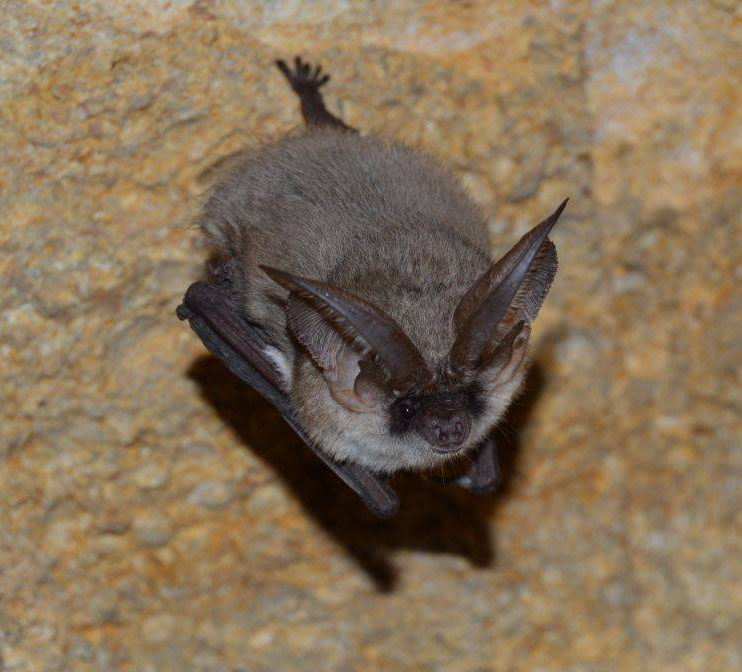
Grey Long-eared Bat
CRCritically Endangered

Grey Long-eared Bat

Plecotus austriacus

The grey long-eared bat is a fairly large European bat. It has distinctive ears, long and with a distinctive fold.

Photo: Wikimedia Commons (CC) via https://en.wikipedia.org/wiki/Grey_long-eared_bat

01Classification

Taxonomy & Classification

Kingdom

Animalia

Phylum

Chordata

Class

Mammalia

Order

Chiroptera

Family

Vespertilionidae

Genus

Plecotus

Grey Long-eared Bat belongs to the family Vespertilionidae, order Chiroptera, within the Mammalia class.

02Description

Species Profile

The grey long-eared bat is a fairly large European bat. It has distinctive ears, long and with a distinctive fold. It hunts above woodland, often by day, and mostly for moths. In captivity, it has also been recorded to eat small lizards. It is extremely similar to the more common brown long-eared bat, and was only distinguished in the 1960s, but has a paler belly.

The Grey Long-eared Bat faces severe population declines primarily due to habitat loss from agricultural intensification and urban development, which eliminates crucial foraging areas and roosting sites. Climate change is altering insect prey availability and distribution patterns, while disturbance to roost sites in buildings and caves further threatens remaining populations.

Key Facts

IUCN StatusCritically Endangered (CR)
GroupMammals
03Habitat

Habitat & Distribution

Its main foraging habitats are lowland meadows and marshes.

04Threats

Threats

!

IUCN Red List: Critically Endangered

The Grey Long-eared Bat faces severe population declines primarily due to habitat loss from agricultural intensification and urban development, which eliminates crucial foraging areas and roosting sites. Climate change is altering insect prey availability and distribution patterns, while disturbance to roost sites in buildings and caves further threatens remaining populations.

Habitat loss from agricultural intensification

HighOngoing

Roost site disturbance and destruction

HighOngoing

Urban development and building renovation

HighOngoing

Climate change impacts on prey availability

MediumOngoing

Light pollution affecting foraging behavior

MediumOngoing
07National Status

National vs Global Threat Status

How this species is assessed at the national level compared to its IUCN global status (CR).

CountryNational StatusGlobal StatusComparison
EULCLeast ConcernCRCritically EndangeredLower local risk

National Red List data sourced from the National Red List Project (nationalredlist.org, ZSL) and country-specific Red List authorities.

Community

Community Sightings

Report a sighting

No community sightings yet. Be the first to report!

07Sources

Sources & Attribution

How to Cite

IUCN: IUCN (2025). The IUCN Red List of Threatened Species. Version 2025-1. Available at: https://www.iucnredlist.org. doi:10.2305/IUCN.UK.2025-1.RLTS

GBIF: GBIF.org (2025). GBIF Home Page. Available at: https://www.gbif.org

National Red Lists: ZSL (2025). National Red List. Zoological Society of London. Available at: https://www.nationalredlist.org

This page: SpeciesRadar (2025). Grey Long-eared Bat (Plecotus austriacus). SpeciesRadar: Intelligence for Earth's Biodiversity. Available at: https://speciesradar.org/species/grey-long-eared-bat

Full citation guide & data usage terms