Armed Nomad Bee
VUVulnerable

Armed Nomad Bee

Nomada armata

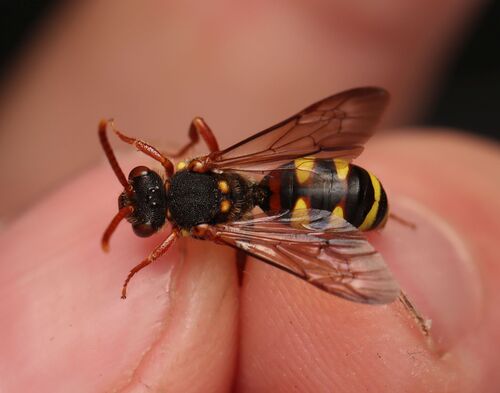
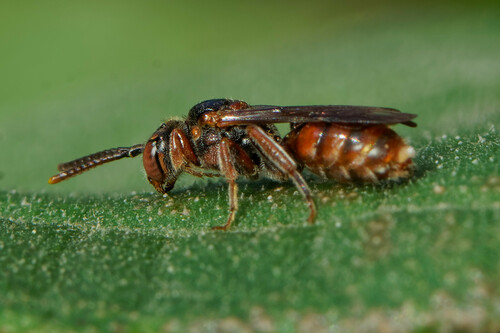
The Armed Nomad Bee (Nomada armata) is a cuckoo bee species characterized by its distinctive wasp-like appearance with yellow and black markings and relatively hairless body. As a kleptoparasite, it does not collect pollen itself but instead lays its eggs in the nests of solitary mining bees, where its larvae consume the host's provisions.

27

Countries

Photo: iNaturalist: (c) RUIZ Jean Marc, all rights reserved, uploaded by RUIZ Jean Marc

01Classification

Taxonomy & Classification

Kingdom

Animalia

Phylum

Arthropoda

Class

Insecta

Order

Hymenoptera

Family

Apidae

Genus

Nomada

Armed Nomad Bee belongs to the family Apidae, order Hymenoptera, within the Insecta class.

02Description

Species Profile

The Armed Nomad Bee (Nomada armata) is a cuckoo bee species characterized by its distinctive wasp-like appearance with yellow and black markings and relatively hairless body. As a kleptoparasite, it does not collect pollen itself but instead lays its eggs in the nests of solitary mining bees, where its larvae consume the host's provisions.

The Armed Nomad Bee faces significant threats from habitat loss due to agricultural intensification and urbanization, which reduces availability of both host bee populations and suitable nesting sites. Climate change and pesticide use further compound these pressures, disrupting the delicate ecological relationships this cuckoo bee depends on for survival.

Key Facts

IUCN StatusVulnerable (VU)
GroupInsects
03Habitat

Habitat & Distribution

Open grasslands, heathlands, coastal dunes, and sandy areas with sparse vegetation where host mining bees (Andrena species) construct their ground nests. Also found in woodland edges, quarries, and other disturbed sandy soils in temperate regions.

04Threats

Threats

Decline of host bee populations

HighOngoing

Habitat loss and fragmentation

HighOngoing

Agricultural intensification and pesticide use

MediumOngoing

Climate change impacts

MediumOngoing

Loss of floral resources

MediumOngoing
07National Status

National vs Global Threat Status

How this species is assessed at the national level compared to its IUCN global status (VU).

CountryNational StatusGlobal StatusComparison
EUNTNear ThreatenedVUVulnerableLower local risk

National Red List data sourced from the National Red List Project (nationalredlist.org, ZSL) and country-specific Red List authorities.

Community

Community Sightings

Report a sighting

No community sightings yet. Be the first to report!

07Sources

Sources & Attribution

How to Cite

IUCN: IUCN (2025). The IUCN Red List of Threatened Species. Version 2025-1. Available at: https://www.iucnredlist.org. doi:10.2305/IUCN.UK.2025-1.RLTS

GBIF: GBIF.org (2025). GBIF Home Page. Available at: https://www.gbif.org

National Red Lists: ZSL (2025). National Red List. Zoological Society of London. Available at: https://www.nationalredlist.org

This page: SpeciesRadar (2025). Armed Nomad Bee (Nomada armata). SpeciesRadar: Intelligence for Earth's Biodiversity. Available at: https://speciesradar.org/species/armed-nomad-bee

Full citation guide & data usage terms