Rufous-necked Hornbill
Aceros nipalensis
Overview
Aceros nipalensis (Rufous-necked Hornbill)
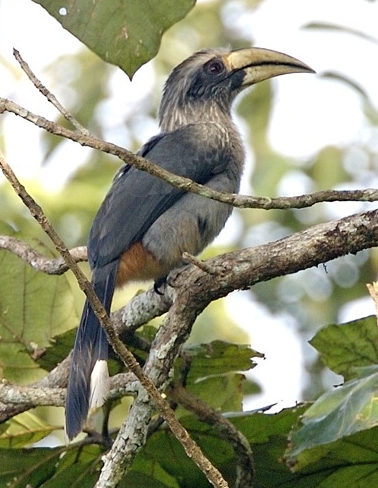
The Rufous-necked Hornbill is a large forest bird distinguished by its prominent casque atop a massive yellow bill and distinctive rufous-colored neck plumage. Males are notably larger than females and possess more pronounced casques. These hornbills are primarily frugivorous, playing a crucial ecological role as seed dispersers for large-seeded forest trees across their range.
They nest in natural tree cavities, where females seal themselves inside during the breeding season while males provide food.
This species inhabits primary and mature secondary forests across the Eastern Himalayas and Southeast Asia, ranging from Nepal and northeastern India through Myanmar, southern China, Thailand, Laos, and Vietnam. They prefer tall, dense canopy forests at elevations typically between 150-1,500 meters, requiring large territories with abundant fruiting trees.
The Rufous-necked Hornbill faces severe pressure from habitat destruction driven by logging operations and agricultural expansion, particularly shifting cultivation practices that fragment forest landscapes. Additionally, intensive hunting for their distinctive casques and meat has significantly reduced populations across much of their range. The species' slow reproductive rate—typically raising only one chick per year—makes recovery particularly challenging.
Conservation efforts include habitat protection within national parks and reserves, anti-poaching initiatives, and community-based conservation programs in several range countries. Research and monitoring programs are tracking remaining populations and breeding success rates.
The species' outlook remains concerning, with continued population declines reported across most of its range. Without enhanced protection of remaining forest habitats and reduced hunting pressure, further population reductions are likely.
The Rufous-necked Hornbill faces serious threats from farmers clearing forests to plant permanent crops like coffee and tea, as well as traditional shifting agriculture where land is cleared and then left to recover. The birds are also hunted for food or trade, and their forest homes are being cut down for timber. All of these threats are currently ongoing and appear to be continuing at similar levels.
Conservation measures underway
Other threatened species in BUCEROTIDAE


Threatened in Bhutan


Frequently asked questions
Why is Rufous-necked Hornbill classified as Vulnerable?
Where does Rufous-necked Hornbill live?
What are the main threats to Rufous-necked Hornbill?
Get weekly conservation intelligence
One short digest a week of the most striking species and country data we ship, plus breaking conservation news paired with our database where it matters.
Free, no spam. One-click unsubscribe in every email.