Great Bittern in Nepal: Endangered Despite Global Safety
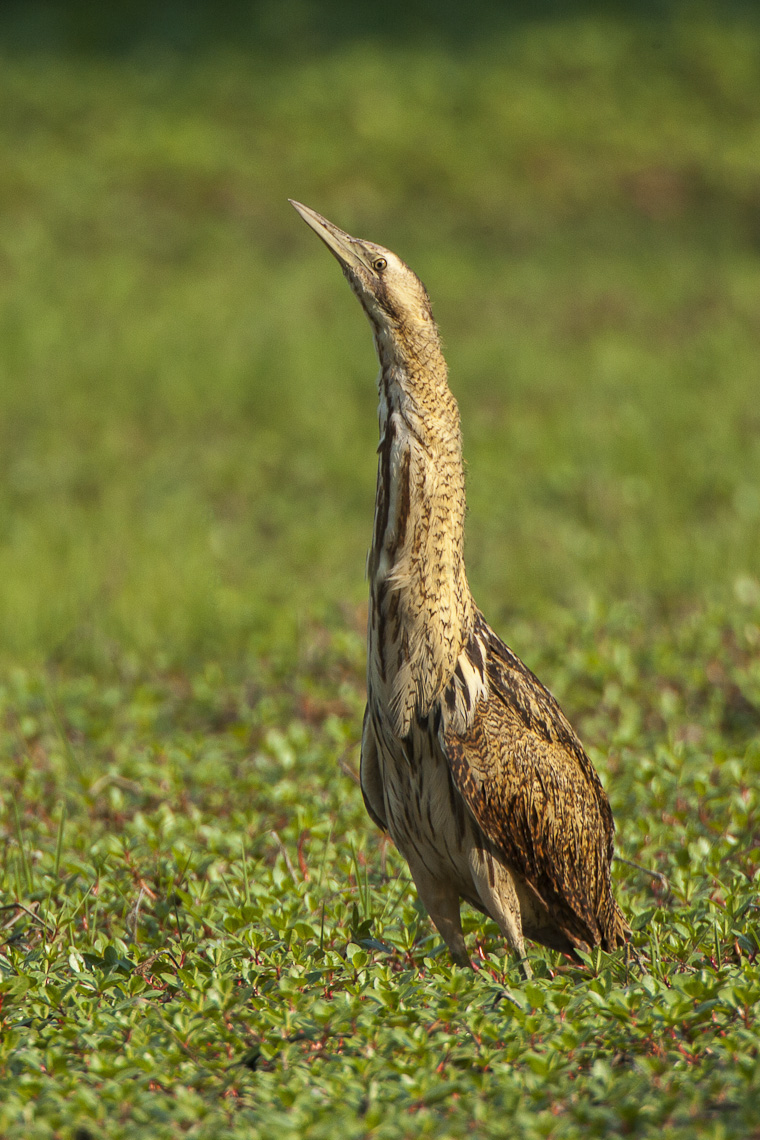
A bird that is "fine" everywhere except where you can actually find it
Here is a paradox that should worry anyone who trusts a single conservation label: the Great Bittern (Botaurus stellaris) is classified as Least Concern on the global IUCN Red List, yet Nepal's own national assessment lists the same species as Endangered. One number says "don't worry." The other says "act now." Both are correct — just at different scales.
| Status Level | Classification | Source |
|---|---|---|
| Global (IUCN Red List) | Least Concern (LC) | IUCN Red List |
| National (Nepal) | Endangered (EN) | National Red List of Nepal's Birds, Baral et al. / Himalayan Nature & BCN |
| Divergence | 3 threat-category jump (LC → EN) | SpeciesRadar cross-reference |
Key Finding: The Great Bittern is assessed as Least Concern globally but Endangered in Nepal — a three-category gap that reveals how a species can be secure worldwide while quietly disappearing from one of its range countries.
This is not a data error. It is exactly the kind of divergence that a global-only view of extinction risk can hide, and it's why national red lists exist alongside the global one in the first place.

Why the same bird can be two different "statuses"
The global IUCN Red List evaluates extinction risk across a species' entire range — for the Great Bittern, that spans wetlands from Western Europe through Central Asia to parts of East Asia. Population losses in one country can be offset, statistically, by stability or growth elsewhere. A species can look perfectly comfortable in a world-scale tally even as it collapses in a specific nation.
Nepal's national assessment, compiled by Baral et al. for Himalayan Nature and Bird Conservation Nepal, asks a narrower and arguably more urgent question: how is this population doing here, in these wetlands, under these pressures? For the Great Bittern, the answer in Nepal is grim enough to warrant Endangered status — even though the species' global population trend is not currently considered to be in freefall.
What's actually happening on the ground
The Great Bittern depends on something increasingly rare in Nepal's lowlands: large, undisturbed reed beds dominated by dense Phragmites stands, interspersed with shallow open water. According to the national assessment, several converging pressures are shrinking that habitat:
- Reed bed drainage for agricultural expansion and urban development, eliminating breeding habitat outright
- Water pollution from agricultural runoff and industrial discharge degrading remaining wetlands
- Water management changes that alter the water-level regimes bitterns need for nesting and foraging
- Climate change impacts shifting vegetation composition and hydrology in the few wetlands that remain suitable
Each of these pressures is intensified in a small, densely populated country like Nepal, where wetland habitat is a fraction of what exists across the species' broader Eurasian range. A reed bed lost to drainage in the Terai lowlands isn't replaceable by habitat hundreds of kilometers away in another country — it's simply gone from the national population's perspective.
What the divergence means for conservation strategy
This gap between global and national status is not a technicality — it has real consequences for where protection money and attention go.
The risk of relying on global status alone
If conservation planners in Nepal used only the global IUCN listing to prioritize species, the Great Bittern would likely receive little dedicated attention, since Least Concern species rarely trigger targeted funding or protected-area management plans. The national Endangered listing corrects that blind spot, flagging a population that needs site-specific action — reed bed protection, pollution control, and water-level management in Nepal's remaining marshes — regardless of how the species fares elsewhere.
Why national red lists matter
National Red Lists, like the one produced for Nepal's birds, exist precisely to catch cases like this. They allow countries to:
- Identify populations facing local extirpation even when the global trend looks stable
- Direct limited conservation resources toward nationally significant wetlands
- Set legal protections tied to domestic conservation priorities, not just global categories
- Track population-specific threats such as localized drainage schemes or pollution sources
A species can be "safe" on a world map and still blink out of an entire country's wetlands — the global label was never designed to catch that.

Comparable cases: the Great Bittern isn't alone
This pattern — globally secure, nationally imperiled — shows up repeatedly in Nepal's national red list, particularly among wetland-dependent birds whose habitat occupies a shrinking footprint in the country's lowlands. Species like the Bengal Florican (Critically Endangered) illustrate the opposite but related problem: a species already flagged as high-risk globally facing even more acute pressure nationally. Comparing cases like the Great Bittern against other wetland and grassland specialists on SpeciesRadar's species explorer shows just how common these national-global mismatches are among habitat specialists with fragmented ranges.
A note on data gaps
It's worth being transparent about the limits here: Nepal's national assessment does not currently report a confirmed population figure or trend direction for the Great Bittern — the trend is listed as unknown. That uncertainty is itself a conservation signal. Species without reliable population monitoring are harder to protect effectively, and the Endangered classification reflects professional judgment about habitat loss severity as much as it does any population count.
Related on SpeciesRadar: Adonis' Ladybird (EN), Dark Bluet (EN).
Frequently Asked Questions
Why is the Great Bittern Endangered in Nepal but Least Concern globally?
Nepal's national assessment measures extinction risk within the country's borders specifically, where wetland habitat loss from drainage, pollution, and water management changes is severe, while the global IUCN assessment considers the species' much larger range across Europe and Asia, where overall numbers remain more stable.
What habitat does the Great Bittern need to survive?
It requires large reed beds dominated by dense Phragmites stands with shallow water, found in natural lakes, marshes, and managed wetland reserves — habitat that is increasingly fragmented in Nepal's lowlands.
Can a species be removed from a national red list if its habitat recovers?
Yes — national red list categories are reassessed periodically, and documented habitat restoration, such as reed bed protection or wetland rehabilitation, can shift a species to a lower-risk category over time.
Are other wetland birds in Nepal facing similar status divergence?
Yes. Wetland and grassland specialists with fragmented ranges, including species like the Bengal Florican, often show different national versus global risk profiles due to localized habitat pressures.
A future that's still within reach
The Great Bittern's story in Nepal is a warning, but not a hopeless one. Reed beds can be restored, water management can be redesigned around breeding seasons rather than against them, and pollution sources can be regulated. Countries that have invested in wetland reserve management have shown that secretive, habitat-specialist birds like bitterns can rebound once the reed beds they depend on are protected and water levels are managed with their nesting needs in mind. Safeguarding Nepal's remaining marshes now — before more reed bed is drained — is the clearest path to pulling this population back from Endangered status.
Explore the Great Bittern's full species profile on SpeciesRadar, browse more of Nepal's threatened species, and read the full national red lists pillar on SpeciesRadar to see how global and national assessments diverge across hundreds of other species.
Methodology: Data sourced from SpeciesRadar (speciesradar.org), drawing on IUCN Red List 2025-2, GBIF, and national red list assessments from the National Red List of Nepal's Birds, compiled by Baral et al. for Himalayan Nature and Bird Conservation Nepal.
Get weekly conservation intelligence
One short digest a week of the most striking species and country data we ship, plus breaking conservation news paired with our database where it matters.
Free, no spam. One-click unsubscribe in every email.