Whitefin Swellshark
Cephaloscyllium albipinnum
Overview
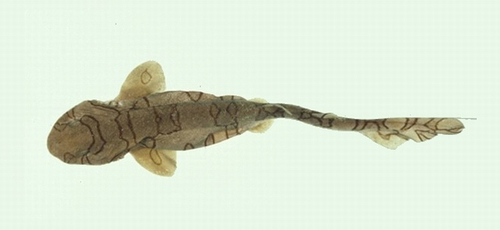
The whitefin swellshark is a species of catshark, belonging to the family Scyliorhinidae, endemic to southeastern Australia. It is found 126–554 m (413–1,818 ft) down, on the outer continental shelf and upper continental slope. Reaching 1.1 m (3.6 ft) in length, this shark has a very thick body and a short, broad, flattened head with a large mouth.
It is characterized by a dorsal color pattern of dark saddles and blotches over a brown to gray background, and light fin margins. When threatened the whitefin swellshark can inflate itself with water or air to increase its size. Reproduction is oviparous.
As of 2019 The International Union for Conservation of Nature (IUCN) has assessed this species as Critically Endangered due to the significant decline of the population.
The Whitefin Swellshark is confined to a narrow band of the upper continental slope off southeastern Australia, an area subject to intensive commercial trawl fishing for scalefish and shark species. As a slow-reproducing demersal shark with a highly restricted range, it is caught incidentally as bycatch in trawl and gillnet fisheries operating at depths of 220–420 metres, with no species-specific management measures in place to reduce mortality. Ongoing trawl effort within its limited depth and geographic range is believed to have driven substantial population decline, and its restricted distribution offers little scope for recolonisation of depleted areas.
Habitat
This species inhabits the upper continental slope off southeastern Australia, typically found on or near the seabed at depths of roughly 220 to 420 metres.
Conservation measures underway
Other threatened species in SCYLIORHINIDAE
Threatened in Australia
Frequently asked questions
Why is Whitefin Swellshark classified as Critically Endangered?
Where does Whitefin Swellshark live?
What are the main threats to Whitefin Swellshark?
Get weekly conservation intelligence
One short digest a week of the most striking species and country data we ship, plus breaking conservation news paired with our database where it matters.
Free, no spam. One-click unsubscribe in every email.