
Translucent Stonewort
Nitella translucens
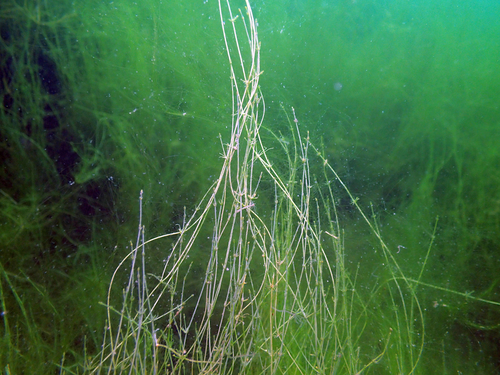
Photo: Wikimedia Commons (CC) via https://en.wikipedia.org/wiki/Nitella_translucens
Overview
Nitella translucens is a submerged freshwater macroalga belonging to the stoneworts, a group of complex green algae in the class Charophyceae that closely resemble vascular plants in structure. It forms branched, whorled thalli anchored to sediment by rhizoids, with translucent, brittle stems that give the species its common name. Like other charophytes, it lacks true roots, stems, and leaves in the botanical sense, but performs analogous functions and reproduces via specialized reproductive structures called oogonia and antheridia.
Ecologically, it contributes to water clarity by stabilizing sediment and competing with phytoplankton for nutrients, while also providing habitat structure for invertebrates and serving as an indicator of water quality.
The species occurs in nutrient-poor to moderately nutrient-rich standing or slow-moving freshwater bodies, including lakes, ponds, and ditches. It has a broad but fragmented distribution, recorded across Europe (including the UK, France, Netherlands, Sweden, and many other countries), as well as in the Americas, Oceania, parts of Africa, and Asia.
Its IUCN status is Vulnerable, with an unknown population trend. Threats include agricultural runoff and eutrophication, which alter water chemistry and favor competing algae; wetland drainage and habitat destruction; urban water pollution; climate-driven changes in water levels; and competition from invasive aquatic plants that outcompete it for light and space.
Conservation measures specific to this species are limited, though it benefits indirectly from wetland protection designations, water quality monitoring programs, and habitat restoration projects in some countries. Its reliance on clean, stable freshwater systems makes it sensitive to ongoing environmental pressures, and without targeted habitat safeguards, its conservation trajectory remains uncertain.
Translucent Stonewort is mainly threatened by fertilizer and manure runoff from farms that pollutes its water with excess nutrients, along with wetlands being drained and converted for other uses. Additional pressure comes from pollution linked to urban growth, changing water levels caused by climate change, and competition from invasive water plants that crowd it out. All of these threats are currently ongoing and show no signs of easing, suggesting the situation is stable to worsening rather than improving.
Habitat
Translucent Stonewort inhabits shallow, clear freshwater environments including ponds, lakes, slow-moving streams, and temporary pools with sandy or muddy substrates. This charophyte requires nutrient-poor to moderately nutrient-rich waters with stable pH levels and minimal disturbance.
Other threatened species in Characeae


Threatened in Argentina

Frequently asked questions
Why is Translucent Stonewort classified as Vulnerable?
Where does Translucent Stonewort live?
What are the main threats to Translucent Stonewort?
Get weekly conservation intelligence
One short digest a week of the most striking species and country data we ship, plus breaking conservation news paired with our database where it matters.
Free, no spam. One-click unsubscribe in every email.