Byssoloma marginatum
Overview
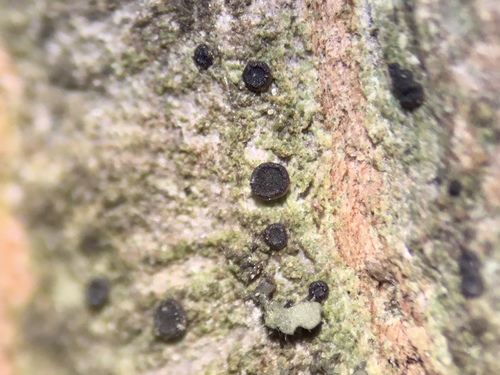
Byssoloma marginatum is a lichenized fungus belonging to the family Byssolomataceae, order Lecanorales. Like other members of this genus, it forms a thin, crustose thallus that grows tightly appressed to bark or leaf surfaces, typically pale greenish-grey in colour, with small disc-shaped fruiting bodies (apothecia) used for sexual reproduction. As a lichen, it is a symbiotic association between a fungal partner and a photosynthetic alga or cyanobacterium, and it plays a minor but persistent role in forest ecosystems as a colonizer of bark surfaces, contributing to microhabitat diversity and nutrient cycling without directly affecting host tree health.
The species has a wide but scattered distribution, recorded across Europe (including the UK, Italy, Germany, Switzerland, Sweden, Norway, Portugal, Ireland, Spain, Poland, and Türkiye), the Americas (United States, Canada, Mexico, Costa Rica, Chile), islands such as Guadeloupe and Réunion, and Australia. It is confined to terrestrial habitats, generally in humid, shaded forest environments where stable moisture and mature tree bark provide suitable substrate.
Its listing as Vulnerable reflects a combination of pressures: air pollution and acid deposition degrade bark chemistry and lichen viability; forest management practices that reduce old-growth stands eliminate the mature trees this species depends on; climate change is altering the humidity and moisture regimes essential to lichen survival; and habitat fragmentation from urban development and intensive agriculture isolates remaining populations.
Conservation responses include protection of old-growth and long-established forest stands within some protected areas, lichen biomonitoring programs that track air quality impacts, and broader forest connectivity initiatives. Population trends remain unknown due to limited monitoring data, and the species' outlook depends heavily on the preservation of mature forest habitat and improvements in regional air quality.
This lichen is losing ground as old-growth forests are cut down or thinned, while polluted air and acid rain damage its habitat. Cities expanding into forested areas and farmland spreading further are breaking up the connected forest patches it needs to survive, and shifting rainfall and humidity patterns from climate change add further stress. Overall, these threats appear to be intensifying rather than easing.
Habitat
Byssoloma marginatum grows as an epiphytic lichen on the bark of mature deciduous and mixed forest trees, particularly favoring species with nutrient-rich, slightly basic bark chemistry. It typically occurs in humid, sheltered forest environments with stable microclimatic conditions and minimal air pollution.
Other threatened species in Byssolomataceae
Threatened in Australia
Frequently asked questions
Why is Byssoloma marginatum classified as Vulnerable?
Where does Byssoloma marginatum live?
What are the main threats to Byssoloma marginatum?
Get weekly conservation intelligence
One short digest a week of the most striking species and country data we ship, plus breaking conservation news paired with our database where it matters.
Free, no spam. One-click unsubscribe in every email.