Arthonia ilicina
Overview
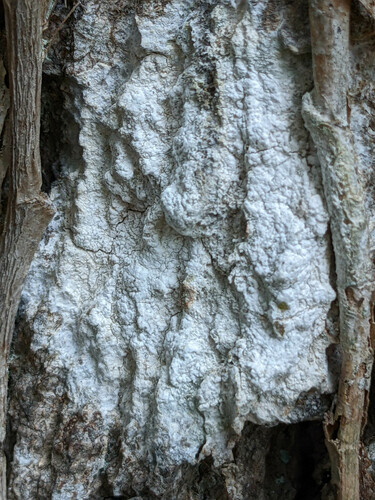
Arthonia ilicina is a crustose lichen-forming fungus in the family Arthoniaceae, distinguished by its thin, inconspicuous thallus that grows embedded within or closely appressed to bark, producing small, irregularly shaped fruiting bodies (ascomata) typical of the genus Arthonia. As with other crustose lichens, it does not move or actively interact with its environment in an animal-like sense; instead, it functions as a bioindicator of air quality and ecosystem stability, and contributes to microhabitat complexity on the bark surfaces it colonizes, supporting invertebrate communities and participating in nutrient cycling on host trees.
The species has a notably wide, disjunct distribution, having been recorded across Europe (Norway, the United Kingdom, Ireland, Denmark, Portugal, Spain, France, Italy), the Americas (Canada, the United States, Mexico, Guyana, Brazil, Colombia, Cuba, Ecuador, Chile, Argentina), as well as South Africa, Australia, and Taiwan. It occupies terrestrial habitats, typically associated with the bark of mature trees in old-growth or long-established woodland stands.
Its conservation concern stems from a combination of ongoing pressures: air pollution and acid deposition, which degrade bark chemistry and lichen viability; urban development and habitat fragmentation, which reduce and isolate suitable host stands; loss of mature host trees through logging and land conversion; climate change altering microclimatic conditions; and forest management practices that reduce structural continuity of woodlands.
No population figures are currently available, and the population trend is listed as unknown. Specific conservation programs targeting this species are not well documented, though it may benefit indirectly from broader forest and lichen conservation initiatives, protected woodland designations, and air quality regulations. Given the persistence of multiple ongoing threats and the absence of trend data, its outlook remains uncertain, warranting continued monitoring under its current Vulnerable classification.
This lichen is mainly threatened by air pollution and acid rain, the loss of old, mature trees it depends on for survival, and the spread of towns and cities breaking up its habitat into small, isolated patches. Forest management practices and shifting climate conditions add further pressure by altering the woodland environments it needs. Overall, these threats appear to be ongoing and stable rather than clearly worsening or improving.
Habitat
This crustose lichen grows exclusively on the smooth bark of holly trees (Ilex species) and occasionally other broad-leaved trees in temperate forests and woodland edges. It requires specific microclimate conditions with moderate humidity and limited direct sunlight, typically found in mature forest understories and sheltered woodland margins.
Other threatened species in Arthoniaceae
Threatened in Argentina

Frequently asked questions
Why is Arthonia ilicina classified as Vulnerable?
Where does Arthonia ilicina live?
What are the main threats to Arthonia ilicina?
Get weekly conservation intelligence
One short digest a week of the most striking species and country data we ship, plus breaking conservation news paired with our database where it matters.
Free, no spam. One-click unsubscribe in every email.