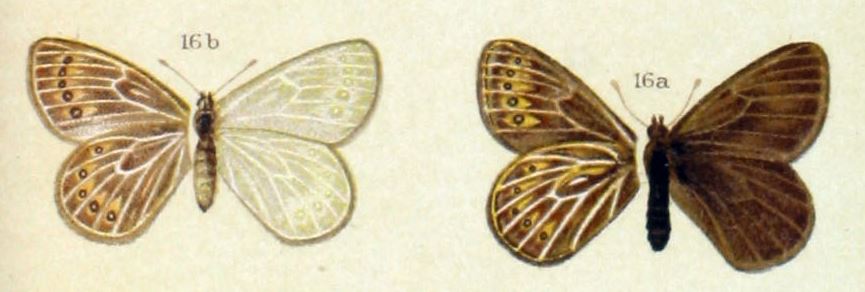
Thor's Fritillary
Boloria thore
Conservation status data sourced from the IUCN Red List of Threatened Species.
Photo: Wikimedia Commons (CC) via https://en.wikipedia.org/wiki/Boloria_thore
Taxonomy & Classification
Kingdom
Animalia
Phylum
Arthropoda
Class
Insecta
Order
Lepidoptera
Family
Nymphalidae
Genus
Boloria
Thor's Fritillary belongs to the family Nymphalidae, order Lepidoptera, within the Insecta class.
Species Profile
Species profile data sourced from the IUCN Red List of Threatened Species.
Thor's Fritillary faces severe population declines due to habitat loss and fragmentation of its specialized alpine and subalpine environments. Climate change poses an additional critical threat as warming temperatures force this cold-adapted species to retreat to increasingly limited high-elevation refugia. The species' dependence on specific host plants and narrow ecological requirements make it particularly vulnerable to environmental changes.
Key Facts
Habitat & Distribution
Alpine and subalpine meadows, grasslands, and heath communities typically above 1,000 meters elevation, often associated with areas containing violet species (Viola) which serve as larval host plants. The species inhabits cool, moist mountain environments with short growing seasons in northern Europe and high-altitude regions.
Threats
IUCN Red List: Critically Endangered
Thor's Fritillary faces severe population declines due to habitat loss and fragmentation of its specialized alpine and subalpine environments. Climate change poses an additional critical threat as warming temperatures force this cold-adapted species to retreat to increasingly limited high-elevation refugia. The species' dependence on specific host plants and narrow ecological requirements make it particularly vulnerable to environmental changes.
Climate change and warming temperatures
Extreme weather events
Habitat loss and fragmentation
Loss of host plant availability
Reduced habitat connectivity
National vs Global Threat Status
How this species is assessed at the national level compared to its IUCN global status (CR).
| Country | National Status | Global Status | Comparison |
|---|---|---|---|
| EU | LCLeast Concern | CRCritically Endangered | Lower local risk |
| EU | LCLeast Concern | CRCritically Endangered | Lower local risk |
National Red List data sourced from the National Red List Project (nationalredlist.org, ZSL) and country-specific Red List authorities.
Community Sightings
Report a sightingNo community sightings yet. Be the first to report!
Sources & Attribution
How to Cite
IUCN: IUCN (2025). The IUCN Red List of Threatened Species. Version 2025-1. Available at: https://www.iucnredlist.org. doi:10.2305/IUCN.UK.2025-1.RLTS
GBIF: GBIF.org (2025). GBIF Home Page. Available at: https://www.gbif.org
National Red Lists: ZSL (2025). National Red List. Zoological Society of London. Available at: https://www.nationalredlist.org
This page: SpeciesRadar (2025). Thor's Fritillary (Boloria thore). SpeciesRadar: Intelligence for Earth's Biodiversity. Available at: https://speciesradar.org/species/thors-fritillary