Indian Sandalwood
Santalum album
Overview
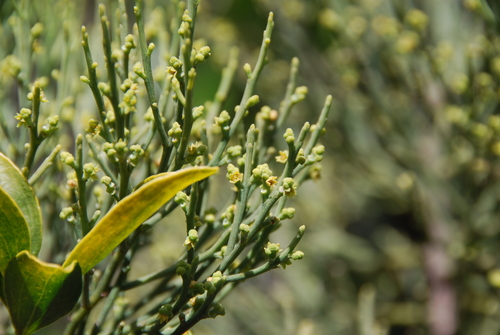
Santalum album is a small, hemiparasitic evergreen tree reaching heights of 4 to 20 meters, distinguished by its dense, fragrant heartwood that has made it one of the most economically valuable trees in the world. As a root hemiparasite, it draws water and nutrients from the roots of neighboring host plants while photosynthesizing independently, a strategy that shapes its distribution within mixed forest communities and links its survival to the presence of suitable host species. Its small, bell-shaped flowers attract insect pollinators, and birds disperse its seeds, giving the species a modest but functional role in local forest ecology.
The species is native to the Indian subcontinent, particularly southern India and Sri Lanka, and has established or naturalized populations across Indonesia, Thailand, China, Australia, Fiji, the Cook Islands, and French Polynesia. It typically grows in tropical and subtropical moist lowland forests, often on rocky or well-drained terrain, from sea level up to around 1,000 meters elevation.
Population decline stems from a combination of pressures: livestock grazing damages seedlings and disrupts regeneration, native pathogens and pest species (including spike disease) weaken mature trees, and recurring fires degrade habitat. Unregulated harvesting of the heartwood, driven by demand for oil and timber, has historically caused severe depletion, particularly in wild populations outside cultivation.
Conservation responses include regulated cultivation and plantation programs in India and Australia, export and harvest controls, and research into disease-resistant strains. Some populations occur within protected forest reserves. Despite these measures, wild populations continue to decline due to ongoing illegal harvesting and habitat pressures, and the species remains classified as Vulnerable, with recovery dependent on sustained enforcement and expanded cultivated supply to reduce pressure on remaining wild stands.
Indian Sandalwood is mainly threatened by grazing livestock damaging young trees and seedlings, and by native pests and diseases (such as spike disease) that weaken or kill the trees. Wildfires and the way fires are managed also put the species at risk, while unsustainable harvesting for its valuable wood continues to reduce populations. These combined pressures appear to be ongoing and stable rather than clearly worsening or improving.
Habitat
Other threatened species in SANTALACEAE
Threatened in Australia
Frequently asked questions
Why is Indian Sandalwood classified as Vulnerable?
Where does Indian Sandalwood live?
What are the main threats to Indian Sandalwood?
Get weekly conservation intelligence
One short digest a week of the most striking species and country data we ship, plus breaking conservation news paired with our database where it matters.
Free, no spam. One-click unsubscribe in every email.