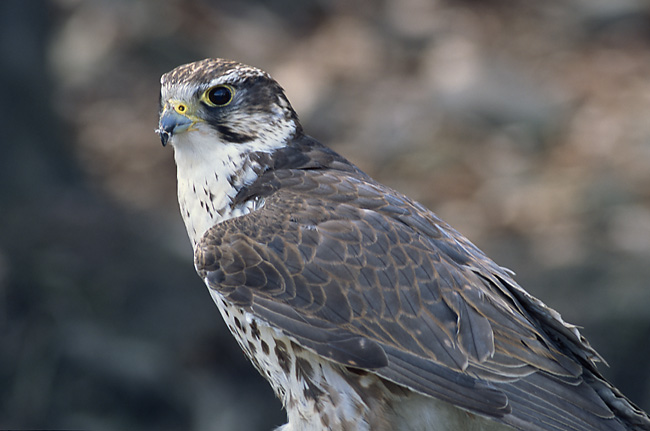
Saker Falcon
Falco cherrug
Photo: Wikimedia Commons (CC) via https://en.wikipedia.org/wiki/Saker_falcon
Overview
The Saker Falcon is a large, powerful raptor measuring 47-55 cm in length with a wingspan reaching 105-129 cm. Distinguished by its broad head, relatively short tail, and variable brown plumage with darker streaking, this species exhibits sexual dimorphism with females significantly larger than males. Saker Falcons are apex predators specializing in hunting ground squirrels, pikas, and other small mammals across open landscapes, playing a crucial role in controlling rodent populations.
This species inhabits vast territories across the Palearctic, from Eastern Europe through Central Asia to Mongolia and China, with wintering populations extending into the Middle East, Indian subcontinent, and parts of Africa. Saker Falcons prefer open steppes, semi-deserts, and agricultural areas with scattered trees or cliffs for nesting.
The species faces severe population declines due to multiple interconnected threats. Intensive agriculture has eliminated prey species and nesting sites, while livestock overgrazing has degraded steppe habitats. Wind energy installations cause direct mortality through collisions.
Illegal capture for falconry remains problematic, particularly affecting breeding adults. Power line electrocutions represent a significant mortality factor, and dam construction has altered traditional hunting grounds.
Conservation efforts include artificial nest box programs, power line modification projects, and international cooperation through the Convention on Migratory Species. Several countries have implemented stricter anti-poaching measures and habitat protection schemes.
Despite these interventions, the Saker Falcon's trajectory remains concerning. Classified as Endangered with continuing population declines, the species requires sustained, coordinated conservation action across its extensive range to prevent further deterioration of its conservation status.
The Saker Falcon faces multiple ongoing threats including the conversion of grasslands to farmland for crops and cattle grazing, which destroys their hunting grounds and nesting sites. They are also threatened by direct capture for the falconry trade, collisions with wind turbines and power lines, and poisoning from agricultural chemicals used on farms. All of these threats are currently ongoing with no clear indication that they are decreasing.
Habitat
Conservation measures underway
Other threatened species in FALCONIDAE



Threatened in Afghanistan

Frequently asked questions
Why is Saker Falcon classified as Endangered?
Where does Saker Falcon live?
What are the main threats to Saker Falcon?
Get weekly conservation intelligence
One short digest a week of the most striking species and country data we ship, plus breaking conservation news paired with our database where it matters.
Free, no spam. One-click unsubscribe in every email.