
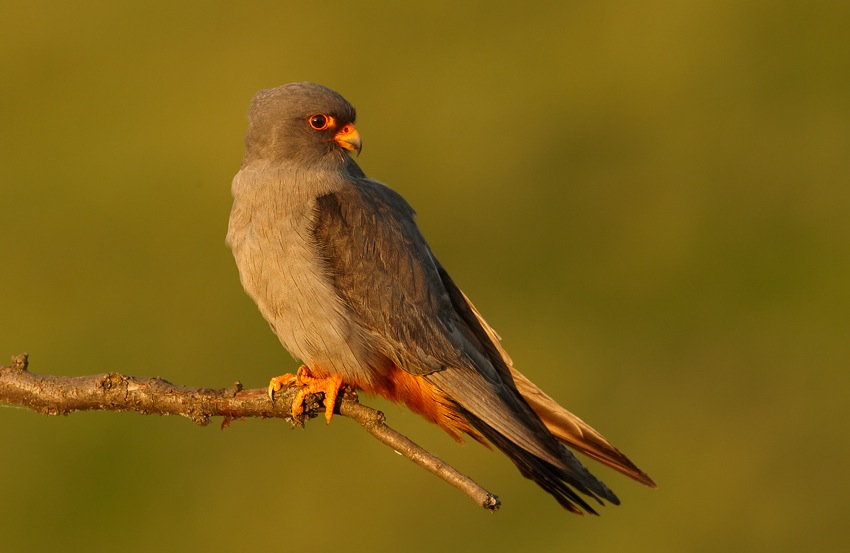
Grey Falcon
Falco hypoleucos
Photo: Wikimedia Commons (CC) via https://en.wikipedia.org/wiki/Grey_falcon
Overview
The Grey Falcon is one of Australia's rarest birds of prey, distinguished by its pale grey-white plumage, dark eyes, and yellow cere and legs. A medium-sized falcon, it relies on fast, agile flight to hunt birds, small mammals, and reptiles, often taking prey in the open through direct pursuit rather than the high-speed stoops typical of some other falcon species. As a top predator, it plays a role in regulating populations of smaller vertebrates within the arid and semi-arid ecosystems it occupies.
This species is endemic to Australia, where it inhabits arid and semi-arid grasslands, deserts, and adjacent shrublands, occasionally ranging into coastal areas. It typically nests in tall trees along watercourses, often reusing old stick nests built by other raptors, and requires large home ranges to secure sufficient prey.
Threats to the Grey Falcon stem largely from land-use change. Livestock farming and ranching alter native vegetation structure and reduce prey availability, while expansion of annual and perennial cropping further fragments habitat. Agricultural effluents can degrade water sources and food chains in already resource-limited landscapes. Invasive species, including introduced predators and competitors, add further pressure on nesting success and prey populations.
Conservation efforts include monitoring of known breeding territories, habitat protection within parts of its range, and research into its ecology and distribution to better inform land management practices. Public reporting of sightings also contributes to population data given the species' elusive nature.
The population is currently assessed as stable, though it remains classified as Vulnerable due to its small overall numbers and reliance on specific habitat conditions. Continued monitoring will be important to ensure this trajectory holds.
The Grey Falcon faces ongoing pressure from livestock grazing that degrades its arid grassland and woodland habitat, along with land conversion for crop farming and runoff from agricultural chemicals contaminating its environment. It is also affected by invasive species, such as introduced predators or competitors, which can disrupt its hunting grounds and prey availability. These threats appear to be ongoing and stable rather than clearly worsening or improving.
Habitat
Conservation measures underway
Other threatened species in FALCONIDAE



Threatened in Australia
Frequently asked questions
Why is Grey Falcon classified as Vulnerable?
Where does Grey Falcon live?
What are the main threats to Grey Falcon?
Get weekly conservation intelligence
One short digest a week of the most striking species and country data we ship, plus breaking conservation news paired with our database where it matters.
Free, no spam. One-click unsubscribe in every email.