
Rock Frog
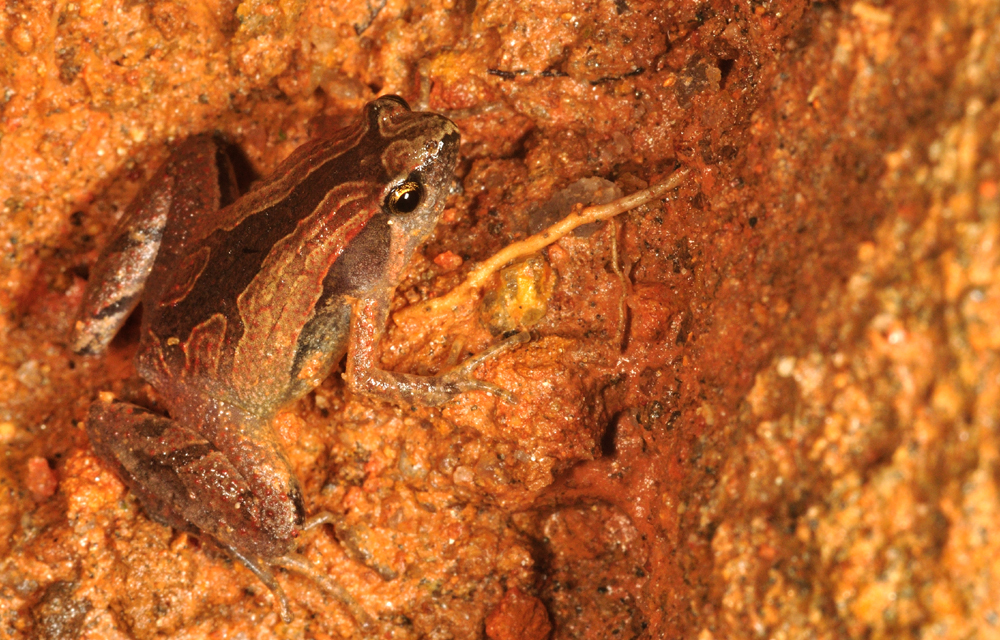
Cophixalus saxatilis
Photo: Wikimedia Commons (CC) via https://en.wikipedia.org/wiki/Black_Mountain_boulder_frog
Overview
Cophixalus saxatilis is a small microhylid frog restricted to the granite boulder fields of far north Queensland. Like other members of its genus, it lacks a free-swimming tadpole stage, instead undergoing direct development within terrestrial eggs laid in moist crevices among rocks. This life history makes it entirely independent of standing water for reproduction, distinguishing it from many other Australian frogs.
Adults are nocturnal and secretive, sheltering deep within rock piles during the day and emerging to forage for small invertebrates at night. As with other amphibians, it likely contributes to local food webs both as predator of invertebrates and as prey for reptiles and birds.
The species is endemic to a small number of mountain summits in Queensland, Australia, where it occupies exposed granite boulder fields and associated microhabitats at high elevation. Its range is naturally fragmented, with populations confined to isolated rocky outcrops separated by unsuitable lowland terrain.
Population numbers are not available, and the trend is currently unknown. Threats include climate change and increasingly severe weather events, which can alter the cool, moist microclimates within boulder fields that the species depends on. Habitat shifting associated with warming temperatures, invasive species, chytrid fungus (a viral/prion-induced disease affecting amphibians broadly), and disturbance from recreational activities such as bushwalking and rock climbing further compound these pressures.
Conservation measures specific to this species are limited, though it benefits from occurring within protected areas and from broader regional monitoring of upland rainforest and rock-dwelling frog species in Queensland. Its restricted range and reliance on stable microhabitats make it inherently vulnerable to ongoing environmental change, and its long-term outlook remains uncertain without further population data.
The Rock Frog faces mounting pressure from climate change and extreme weather events, which are altering the mountaintop habitat it depends on. It also faces risks from invasive species that can prey on or compete with it, a viral disease, and disturbance from recreational activities in its habitat. These threats are all currently ongoing, suggesting a stable but persistent level of risk rather than a clear increase or decrease.
Habitat
The Rock Frog inhabits moist rocky areas and boulder fields within montane rainforests of northeastern Queensland, typically at elevations between 300-1,200 meters. It requires specific microhabitats with permanent moisture, often found near streams or in areas with consistent high humidity.
Other threatened species in Microhylidae

Threatened in Australia
Frequently asked questions
Why is Rock Frog classified as Vulnerable?
Where does Rock Frog live?
What are the main threats to Rock Frog?
Get weekly conservation intelligence
One short digest a week of the most striking species and country data we ship, plus breaking conservation news paired with our database where it matters.
Free, no spam. One-click unsubscribe in every email.