
Disk Coral
Heliofungia actiniformis
Photo: Wikimedia Commons (CC) via https://en.wikipedia.org/wiki/Heliofungia_actiniformis
Overview
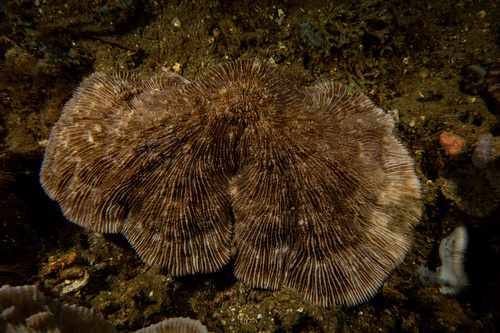
Heliofungia actiniformis is a large solitary stony coral distinguished by an oval, disk-shaped skeleton and long, fleshy tentacles that give it an anemone-like appearance, a resemblance reflected in its common name. Unlike colonial corals, each individual exists as a single free-living polyp, typically unattached to the substrate as an adult, allowing limited movement across the seafloor. Its tentacles house symbiotic zooxanthellae for energy through photosynthesis while also capturing plankton, and the species contributes to the structural and biological diversity of reef habitats where it occurs.
The species inhabits shallow coral reef environments across a broad Indo-Pacific range, including Australia, Indonesia, the Philippines, Palau, New Caledonia, Papua New Guinea, Malaysia, Japan, Singapore, Vanuatu, the Solomon Islands, Timor-Leste, Thailand, Fiji, the Maldives, the United States, and Mayotte, generally on sandy or reef-flat areas within lagoons and sheltered reef slopes.
Its IUCN status of Vulnerable stems from a combination of pressures affecting reef ecosystems broadly. Rising sea temperatures drive coral bleaching by disrupting the coral–algae symbiosis, while ocean acidification impairs skeletal formation. Predation by crown-of-thorns starfish outbreaks adds localized mortality, and coastal development, sedimentation, and pollution from land-based runoff degrade water quality and smother reef habitat.
The species has also faced targeted collection for the marine aquarium trade due to its distinctive appearance.
Conservation efforts include its listing under CITES Appendix II to regulate international trade, inclusion in marine protected areas across parts of its range, and broader reef management and water-quality initiatives. Population trends remain unknown due to limited monitoring data. Given ongoing climate-related reef stressors and continued habitat degradation, the species' long-term outlook remains uncertain without sustained reef protection and emissions mitigation.
Disk Coral faces serious danger from warming oceans, which causes it to bleach and die, while more acidic seawater makes it harder for the coral to build its skeleton. It's also being eaten by outbreaks of crown-of-thorns starfish and smothered by sediment and pollution washing in from coastal construction and land runoff. These combined pressures appear to be intensifying rather than easing.
Habitat
This large solitary coral inhabits shallow tropical reef environments across the Indo-Pacific, typically found on sandy bottoms and reef slopes at depths of 5-40 meters. It requires clear, warm waters with stable temperatures and adequate light penetration for its symbiotic zooxanthellae to photosynthesize effectively.
Other threatened species in Fungiidae
Threatened in Australia
Frequently asked questions
Why is Disk Coral classified as Vulnerable?
Where does Disk Coral live?
What are the main threats to Disk Coral?
Get weekly conservation intelligence
One short digest a week of the most striking species and country data we ship, plus breaking conservation news paired with our database where it matters.
Free, no spam. One-click unsubscribe in every email.