Phipps' Monkey Grasshopper
Euschmidtia phippsi
Overview
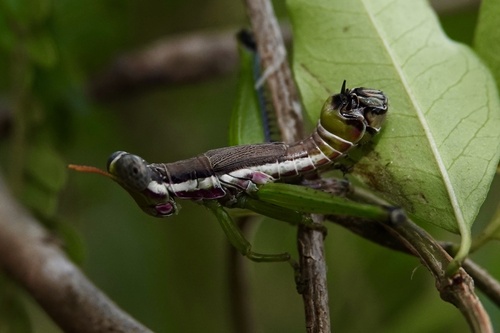
Phipps' Monkey Grasshopper (Euschmidtia phippsi) is a small, cryptically coloured grasshopper belonging to the monkey grasshopper family (Eumastacidae), a group known for their compact bodies, short wings or wing loss, and reliance on dense vegetation for camouflage and movement. Like other members of its genus, it is likely flightless or has greatly reduced flying ability, moving instead by climbing and hopping through low shrubs and grasses. The species is restricted to a narrow range within South Africa's fynbos and grassland habitats, ecosystems already recognised as global biodiversity hotspots under severe pressure from agricultural expansion and urban development.
Euschmidtia phippsi is currently classified as Critically Endangered (CR) by the IUCN, reflecting an extremely limited and fragmented distribution coupled with ongoing habitat degradation. Because monkey grasshoppers generally have poor dispersal ability and highly specific microhabitat requirements, even small-scale disturbances to their vegetation can have outsized effects on local populations. Conservation attention for South Africa's fynbos-associated invertebrates has increased in recent years, with habitat protection initiatives in the Cape Floristic Region offering indirect benefits to lesser-known species like this grasshopper.
Encouragingly, growing regional efforts to map and protect remaining fragments of natural vegetation in the Western Cape provide a meaningful opportunity to safeguard remaining populations before further decline occurs. Continued taxonomic and ecological research is needed to refine understanding of its precise range and habitat needs, but its CR status underscores the urgency of prioritising surveys and habitat safeguards for this narrowly distributed insect.
Euschmidtia phippsi faces severe threats from deep-sea mining activities and bottom trawling that directly destroy its sponge habitat on seamounts and abyssal plains. Climate change-induced ocean acidification and warming temperatures further compromise this species' survival by altering the chemical composition of seawater essential for its calcium carbonate skeletal structure. The species' extremely limited distribution and slow growth rates make recovery from disturbances nearly impossible.
Habitat
This deep-sea sponge inhabits abyssal and bathyal zones on rocky substrates, typically found on seamounts and continental slopes at depths exceeding 1,000 meters. The species requires stable, cold-water environments with minimal sediment disturbance and specific water chemistry conditions.
Other threatened species in EUSCHMIDTIIDAE
Threatened in Kenya
Frequently asked questions
Why is Phipps' Monkey Grasshopper classified as Critically Endangered?
Where does Phipps' Monkey Grasshopper live?
What are the main threats to Phipps' Monkey Grasshopper?
Get weekly conservation intelligence
One short digest a week of the most striking species and country data we ship, plus breaking conservation news paired with our database where it matters.
Free, no spam. One-click unsubscribe in every email.