
One-toothed silvan flat bark beetle
Silvanus unidentatus
Photo: Wikimedia Commons (CC) via https://en.wikipedia.org/wiki/Silvanus_unidentatus
Overview
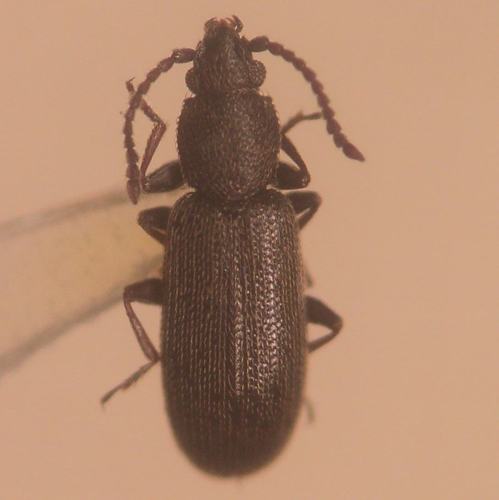
Silvanus unidentatus is a small, flattened beetle typically measuring a few millimeters in length, with an elongated reddish-brown to dark brown body adapted for slipping beneath bark and into narrow crevices in decaying wood. Its flattened profile, characteristic of the family Silvanidae, allows it to exploit the tight spaces beneath loose bark where it feeds primarily on fungi, decaying plant matter, and possibly small invertebrates associated with rotting wood. As a saproxylic species, it plays a role in the decomposition of dead and dying trees, contributing to nutrient cycling in forest ecosystems.
The species has an unusually broad distribution, recorded across much of Europe—including France, Germany, the United Kingdom, Poland, and Russia—as well as in more distant locations such as the United States, Mexico, Australia, New Zealand, and Mongolia. It is restricted to terrestrial habitats, particularly forests with adequate deadwood substrate.
Its Vulnerable status stems from the loss and degradation of the deadwood habitat it depends on. Commercial logging and wood harvesting remove standing and fallen timber before it can reach the decay stages the beetle requires. Agricultural expansion further fragments woodland, while forest fragmentation more broadly isolates populations and limits dispersal.
Climate change and severe weather events alter forest composition and moisture regimes affecting fungal growth on deadwood, and competition from invasive species adds additional pressure.
Conservation measures are not well documented at the species level, though general deadwood retention policies and forest management reforms in parts of Europe may incidentally benefit it. Population trends remain unknown due to limited monitoring, making its trajectory difficult to assess with confidence, though ongoing habitat pressures suggest continued vulnerability.
This beetle is losing its home as forests are cut down for timber and cleared to make way for farmland, which breaks up the large, connected woodlands it depends on into smaller, isolated patches. It also faces pressure from competing invasive species that move into its habitat, while shifting weather patterns and rising temperatures add further strain. These combined pressures appear to be ongoing and show no signs of easing, suggesting the threats are intensifying rather than stabilizing.
Habitat
This beetle inhabits mature deciduous and mixed forests, particularly favoring areas with abundant dead and decaying hardwood trees. The species requires specific microhabitats within rotting logs and bark crevices where it feeds on fungi and organic matter.
Other threatened species in Silvanidae
Threatened in Australia
Frequently asked questions
Why is One-toothed silvan flat bark beetle classified as Vulnerable?
Where does One-toothed silvan flat bark beetle live?
What are the main threats to One-toothed silvan flat bark beetle?
Get weekly conservation intelligence
One short digest a week of the most striking species and country data we ship, plus breaking conservation news paired with our database where it matters.
Free, no spam. One-click unsubscribe in every email.