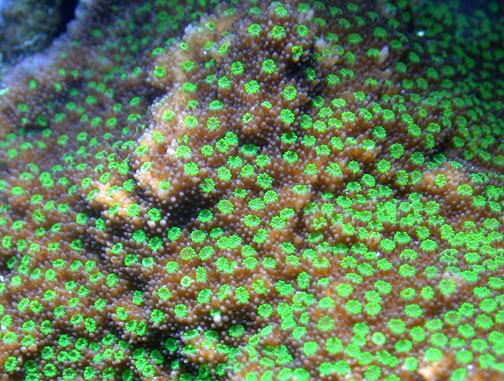
Montipora grisea
Photo: Wikimedia Commons (CC) via https://en.wikipedia.org/wiki/Montipora_grisea
Overview
Montipora grisea is a colonial stony coral in the family Acroporidae, typically forming encrusting to plate-like or branching colonies depending on local conditions. Like other scleractinian corals, it builds a calcium carbonate skeleton and hosts symbiotic zooxanthellae, algae that supply the coral with energy through photosynthesis while the coral provides shelter and nutrients in return. Colonies extend polyps to capture plankton, particularly at night, supplementing their symbiotic energy intake.
As a reef-building species, it contributes to the structural complexity of reef systems, providing habitat for numerous invertebrates and fish.
The species occupies marine neritic (shallow coastal) waters across a broad Indo-Pacific range, spanning countries including the Marshall Islands, Papua New Guinea, Solomon Islands, New Caledonia, Madagascar, Micronesia, Seychelles, Australia, Mauritius, Maldives, Thailand, Vanuatu, Vietnam, Taiwan, China, Japan, Palau, and Fiji.
Its decline stems from a combination of pressures rather than a single cause. Fishing and harvesting activities damage colonies directly, while recreational activities such as diving and anchoring cause physical breakage. Coral disease and outbreaks of problematic native species, such as crown-of-thorns starfish, further degrade colonies.
Land-based pollution—domestic wastewater, agricultural runoff, and effluents from non-timber crop production—reduces water quality and promotes algal overgrowth. Habitat alteration and invasive species add further stress, compounding the effects of warming-driven bleaching events.
Conservation efforts include the species' listing under the IUCN Red List as Endangered, inclusion in regional marine protected areas across its range, and broader reef management and water-quality initiatives in affected countries. No population figures are available. Given the persistence of multiple concurrent threats and the ongoing decreasing population trend, the species' outlook remains poor without substantial improvements in coastal water quality and reef protection.
This coral faces ongoing damage from fishing and harvesting activities, along with disturbance from recreational use of its reef habitat. It is further threatened by pollution from sewage, agricultural runoff, and farming operations near the coast, as well as competition from invasive species and disease. Additional stress comes from changes to its habitat and shifting environmental conditions. Based on the continued and wide-ranging nature of these pressures, the threats to this species appear to be ongoing and stable rather than clearly increasing or decreasing.
Habitat
Conservation measures underway
Other threatened species in ACROPORIDAE

Threatened in Australia
Frequently asked questions
Why is Montipora grisea classified as Endangered?
Where does Montipora grisea live?
What are the main threats to Montipora grisea?
Get weekly conservation intelligence
One short digest a week of the most striking species and country data we ship, plus breaking conservation news paired with our database where it matters.
Free, no spam. One-click unsubscribe in every email.