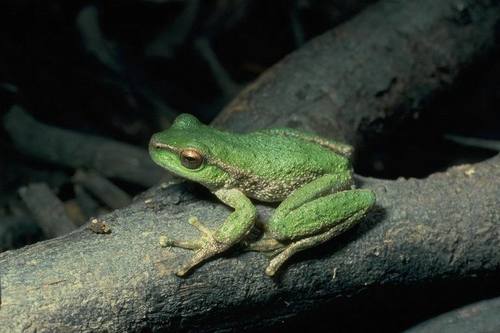
Litoria spenceri
Local name: Spencer’s River Tree Frog
Photo: (c) Jean-Marc Hero, some rights reserved (CC BY-SA)
Overview
Litoria spenceri is a small, slender-bodied frog with smooth brown to olive-green skin marked with darker blotches, and distinctive orange-red patches on the concealed surfaces of its thighs and groin. Adults typically measure under 5 cm in length. Like other members of the genus, it has expanded toe discs that allow it to grip rock and vegetation along fast-flowing water.
It is largely nocturnal, sheltering by day under rocks or in streamside crevices, and feeds on insects and other invertebrates. As both predator and prey within riparian food webs, it contributes to nutrient cycling and insect population control along the watercourses it inhabits.
The species is restricted to a limited number of river systems in southeastern Australia, occupying rocky, permanent streams within forested montane and dry subtropical habitats, typically at higher elevations in Victoria and adjoining parts of New South Wales.
Its decline stems from a combination of pressures: mining and quarrying activity disturbing streambeds, road and logging operations increasing sedimentation, altered water flow from dams and water management, and habitat degradation linked to agriculture, urban development, and infrastructure in riparian zones. Chytrid fungus has caused significant mortality, while drought and shifting climate conditions further stress breeding habitat. Fire and post-fire erosion compound these effects.
Conservation efforts include captive breeding and reintroduction programs, disease and population monitoring, habitat protection along key stream reaches, and restrictions on activities that disturb riparian zones in known populations. Some populations are managed within protected areas.
Despite these interventions, the species remains classified as Critically Endangered with a decreasing population trend. Its restricted range, combined with multiple compounding and ongoing threats, means its long-term recovery remains uncertain without sustained management.
Spencer's River Tree Frog is losing and struggling to reproduce in its stream habitats due to human activities like mining, road building, logging, and farming near waterways, which cause pollution and physical damage to the rivers it depends on. It also faces serious risks from a deadly skin disease called chytrid fungus, competition or predation from invasive species, and climate change, which is altering water conditions needed for breeding. On top of this, droughts, fires, and dam-related water management further disrupt its habitat, making survival increasingly difficult. These combined threats appear to be intensifying rather than easing.
Habitat
Spencer's Tree Frog inhabits cool, permanent mountain streams and adjacent wet sclerophyll forests in the Australian Alps region of Victoria and New South Wales. The species requires rocky stream beds with overhanging vegetation and maintains strong site fidelity to specific breeding pools at elevations typically above 400 meters.
Conservation measures underway
Other threatened species in PELODRYADIDAE

Threatened in Australia
Frequently asked questions
Why is Spencer’s River Tree Frog classified as Critically Endangered?
Where does Spencer’s River Tree Frog live?
What are the main threats to Spencer’s River Tree Frog?
Get weekly conservation intelligence
One short digest a week of the most striking species and country data we ship, plus breaking conservation news paired with our database where it matters.
Free, no spam. One-click unsubscribe in every email.