Disciseda candida
Overview
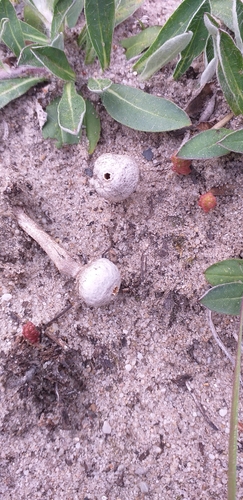
Disciseda candida is a puffball-type fungus in the family Agaricaceae, notable for its distinctive fruiting body: a rounded spore sac partially embedded in a basal disc of soil and debris, which anchors the fungus to the ground and often gives it a saucer-like or pedestal appearance once the outer covering weathers away. Like other gasteroid fungi, it disperses spores passively through wind and rain splash after the outer wall ruptures, rather than through active spore discharge. Ecologically, it functions as a saprotroph, breaking down organic matter in soil and contributing to nutrient cycling within grassland ecosystems.
The species has a notably wide but patchy distribution, recorded across dozens of countries spanning Europe, the Americas, Africa, Asia, and Oceania. It is strictly terrestrial, associated with calcareous and sandy grasslands, dunes, and other open, well-drained soils where competition from dense vegetation is limited.
Its conservation status as Vulnerable reflects pressure from multiple converging threats. Agricultural intensification is destroying calcareous grassland habitat outright, while urban development fragments remaining populations into isolated patches. Overgrazing degrades the specific microhabitat conditions the fungus depends on, and recreational activity causes soil compaction that disrupts the substrate needed for fruiting.
Climate change is altering soil moisture regimes in ways that may further limit suitable conditions.
Formal, species-specific conservation programs remain limited, with protection largely occurring incidentally through broader grassland and dune habitat conservation efforts in parts of its range. Population trends are currently unknown due to limited monitoring data. Given the ongoing, multi-pronged habitat pressures and lack of targeted intervention, the species' long-term outlook remains uncertain without improved habitat protection and monitoring.
This small puffball fungus is losing its grassy, lime-rich habitat as farmland is intensively farmed and towns and cities expand into the countryside, while too much livestock grazing and foot traffic from outdoor recreation compact and degrade the soil it needs to grow. Climate change is also shifting soil moisture levels in ways that may make conditions less suitable for it. These threats are ongoing and show no signs of letting up, suggesting the pressure on this species is likely to continue or intensify.
Habitat
Disciseda candida inhabits open calcareous grasslands, sandy heathlands, and disturbed ground with well-drained, alkaline soils. The species requires specific microhabitat conditions including partial shade and stable soil moisture levels for successful reproduction.
Other threatened species in Agaricaceae


Threatened in Argentina

Frequently asked questions
Why is Disciseda candida classified as Vulnerable?
Where does Disciseda candida live?
What are the main threats to Disciseda candida?
Get weekly conservation intelligence
One short digest a week of the most striking species and country data we ship, plus breaking conservation news paired with our database where it matters.
Free, no spam. One-click unsubscribe in every email.