Killarney Featherwort
Plagiochila bifaria
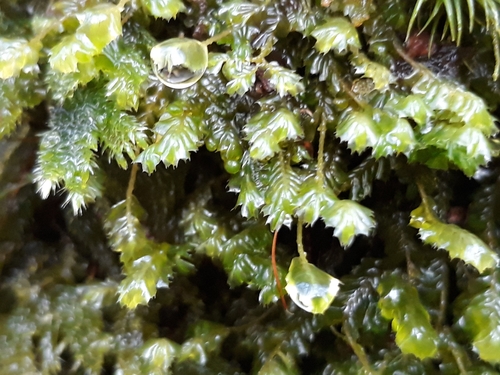
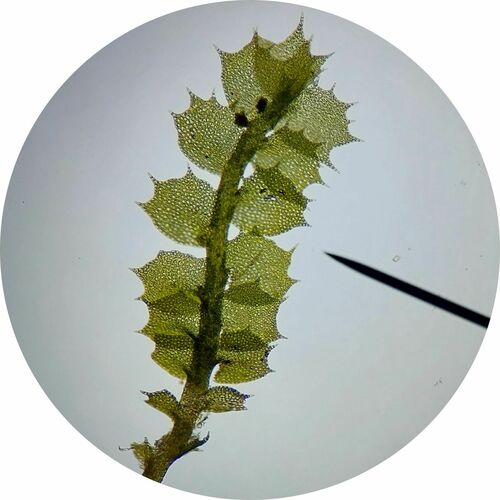
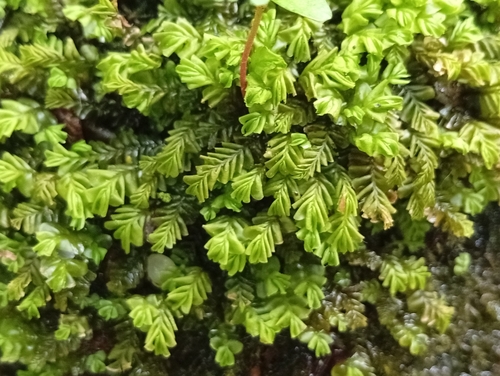
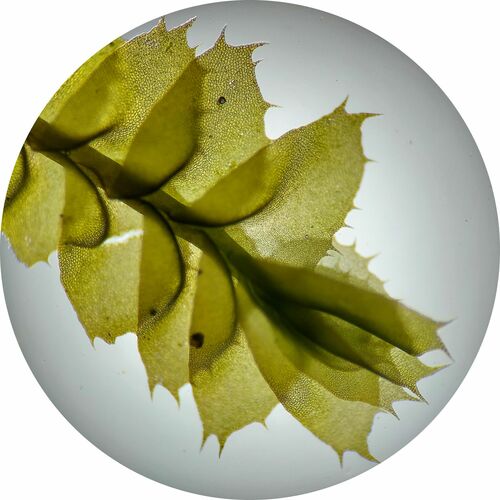
Killarney Featherwort is a rare leafy liverwort with distinctive deeply bifurcated (two-lobed) leaves that give it a delicate, feathery appearance. This small bryophyte forms thin, creeping mats on moist surfaces and plays an important role in specialized microhabitat ecosystems by helping retain moisture and providing shelter for microscopic invertebrates.
Taxonomy & Classification
Kingdom
Plantae
Phylum
Marchantiophyta
Class
Jungermanniopsida
Order
Jungermanniales
Family
Plagiochilaceae
Genus
Plagiochila
Killarney Featherwort belongs to the family Plagiochilaceae, order Jungermanniales, within the Jungermanniopsida class.
Species Profile
Killarney Featherwort is a rare leafy liverwort with distinctive deeply bifurcated (two-lobed) leaves that give it a delicate, feathery appearance. This small bryophyte forms thin, creeping mats on moist surfaces and plays an important role in specialized microhabitat ecosystems by helping retain moisture and providing shelter for microscopic invertebrates.
Killarney Featherwort (Plagiochila bifaria) is critically endangered due to its extremely limited distribution and vulnerability to habitat degradation. This rare bryophyte is restricted to very specific microhabitat conditions in Ireland and faces ongoing threats from environmental changes and human disturbance. Climate change and altered precipitation patterns pose additional risks to its specialized ecological requirements.
Key Facts
Habitat & Distribution
Killarney Featherwort grows exclusively on damp, shaded rock faces and cliff crevices in areas with consistent moisture from seepage or spray. It requires very specific microclimatic conditions found in sheltered gorges and ravines with stable humidity and protection from direct sunlight.
Threats
IUCN Red List: Critically Endangered
Killarney Featherwort (Plagiochila bifaria) is critically endangered due to its extremely limited distribution and vulnerability to habitat degradation. This rare bryophyte is restricted to very specific microhabitat conditions in Ireland and faces ongoing threats from environmental changes and human disturbance. Climate change and altered precipitation patterns pose additional risks to its specialized ecological requirements.
Climate change and altered precipitation patterns
Extremely limited distribution and small population size
Habitat degradation and disturbance
Air pollution and atmospheric nitrogen deposition
Tourism and recreational pressure
National vs Global Threat Status
How this species is assessed at the national level compared to its IUCN global status (CR).
| Country | National Status | Global Status | Comparison |
|---|---|---|---|
| EU | LCLeast Concern | CRCritically Endangered | Lower local risk |
| EU | LCLeast Concern | CRCritically Endangered | Lower local risk |
National Red List data sourced from the National Red List Project (nationalredlist.org, ZSL) and country-specific Red List authorities.
Community Sightings
Report a sightingNo community sightings yet. Be the first to report!
Sources & Attribution
How to Cite
IUCN: IUCN (2025). The IUCN Red List of Threatened Species. Version 2025-1. Available at: https://www.iucnredlist.org. doi:10.2305/IUCN.UK.2025-1.RLTS
GBIF: GBIF.org (2025). GBIF Home Page. Available at: https://www.gbif.org
National Red Lists: ZSL (2025). National Red List. Zoological Society of London. Available at: https://www.nationalredlist.org
This page: SpeciesRadar (2025). Killarney Featherwort (Plagiochila bifaria). SpeciesRadar: Intelligence for Earth's Biodiversity. Available at: https://speciesradar.org/species/killarney-featherwort