ENEndangered

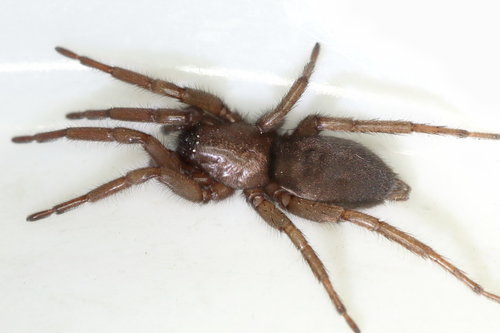
Phaeocedus braccatus

Local name: fläckmarkspindel

The fläckmarkspindel (Phaeocedus braccatus) is a distinctive ground-dwelling spider characterized by its mottled brown and gray coloration that provides excellent camouflage against forest floor substrates. This medium-sized arachnid plays a crucial role as both predator and prey in woodland ecosystems, helping to control populations of small invertebrates while serving as food for birds and other arthropod predators.

26

Countries

01Classification

Taxonomy & Classification

Kingdom

Animalia

Phylum

Arthropoda

Class

Arachnida

Order

Araneae

Family

Gnaphosidae

Genus

Phaeocedus

Phaeocedus braccatus belongs to the family Gnaphosidae, order Araneae, within the Arachnida class.

02Description

Species Profile

The fläckmarkspindel (Phaeocedus braccatus) is a distinctive ground-dwelling spider characterized by its mottled brown and gray coloration that provides excellent camouflage against forest floor substrates. This medium-sized arachnid plays a crucial role as both predator and prey in woodland ecosystems, helping to control populations of small invertebrates while serving as food for birds and other arthropod predators.

Phaeocedus braccatus faces severe population decline primarily due to habitat destruction from agricultural expansion and urban development in its limited range. The species' highly specialized habitat requirements and small population size make it particularly vulnerable to environmental changes and human disturbance.

Key Facts

IUCN StatusEndangered (EN)
GroupArachnids
03Habitat

Habitat & Distribution

This species inhabits the leaf litter and upper soil layers of mature deciduous and mixed forests, particularly favoring areas with dense canopy cover that maintain consistent moisture levels. They are most commonly found in undisturbed forest patches with rich organic matter accumulation and minimal human disturbance.

04Threats

Threats

!

IUCN Red List: Endangered

Phaeocedus braccatus faces severe population decline primarily due to habitat destruction from agricultural expansion and urban development in its limited range. The species' highly specialized habitat requirements and small population size make it particularly vulnerable to environmental changes and human disturbance.

Habitat loss from agricultural conversion

HighOngoing

Urban development and infrastructure expansion

HighOngoing

Climate change affecting microhabitat conditions

MediumOngoing

Small population size and genetic bottlenecks

MediumOngoing

Collection pressure for scientific specimens

LowOngoing
Community

Community Sightings

Report a sighting

No community sightings yet. Be the first to report!

07Sources

Sources & Attribution

How to Cite

IUCN: IUCN (2025). The IUCN Red List of Threatened Species. Version 2025-1. Available at: https://www.iucnredlist.org. doi:10.2305/IUCN.UK.2025-1.RLTS

GBIF: GBIF.org (2025). GBIF Home Page. Available at: https://www.gbif.org

This page: SpeciesRadar (2025). Phaeocedus braccatus (Phaeocedus braccatus). SpeciesRadar: Intelligence for Earth's Biodiversity. Available at: https://speciesradar.org/species/flackmarkspindel

Full citation guide & data usage terms