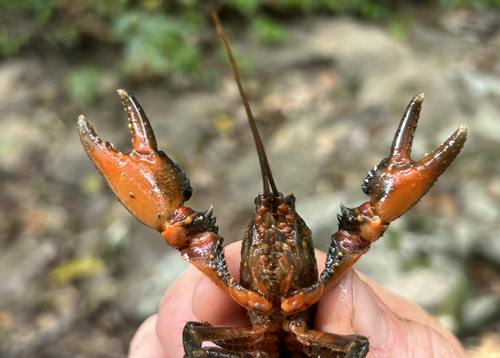
Ochre-Bellied Crayfish
Euastacus mirangudjin
Photo: Photo: (c) Ollie Scully, some rights reserved (CC BY-NC), uploaded by Ollie Scully
Overview
This large freshwater crayfish belongs to the genus Euastacus, a group of spiny, slow-growing crustaceans endemic to eastern Australia. Like its relatives, it likely possesses a robust, spined exoskeleton, prominent claws, and the ochre-toned coloration on its underside reflected in its common name. As a benthic invertebrate, it plays a role in freshwater ecosystems as both a detritivore and prey species, contributing to nutrient cycling and the food web of forested stream systems.
Euastacus species are generally long-lived and slow to reproduce, making populations vulnerable to sustained pressure.
The species occurs only in Australia, inhabiting permanent rivers and streams within forested landscapes. Its restricted range and reliance on cool, well-oxygenated freshwater habitat typify the genus, many members of which are confined to small upland catchments.
No confirmed population figures are available, and the trend remains unknown, but the species is classified as Critically Endangered. It faces a wide array of ongoing threats, including invasive species and disease, logging and associated habitat disturbance, agricultural expansion, and urban development encroaching on its stream habitat. Sedimentation and water pollution from agricultural runoff degrade water quality, while climate change and temperature extremes threaten the cool-water conditions the species depends on.
Unregulated harvesting adds further pressure.
Specific conservation actions targeting this species are not well documented, though broader efforts to protect freshwater habitats and forested catchments in Australia may offer indirect benefit, alongside general regulations on aquatic harvesting.
Given the breadth and persistence of threats affecting both the species and its habitat, combined with its narrow range and biological vulnerability, the species' outlook remains precarious without targeted habitat protection and monitoring.
The Ochre-Bellied Crayfish faces mounting pressure as its stream habitats are cleared and altered for farming, logging, and housing development, while runoff from agricultural land pollutes the water and washes sediment into its habitat. It's also threatened by invasive species, being caught or harvested by people, and rising temperatures and shifting weather patterns linked to climate change that affect the streams it depends on. Since all of these threats are currently listed as ongoing and span multiple compounding pressures (habitat, climate, pollution, and human activity), the overall threat level appears to be intensifying rather than stable or improving.
Habitat
This freshwater crayfish inhabits cool, clear mountain streams and their associated riparian zones in southeastern Australia. It requires well-oxygenated waters with rocky substrates and overhanging vegetation for shelter and foraging.
Conservation measures underway
Other threatened species in PARASTACIDAE
Threatened in Australia
Frequently asked questions
Why is Ochre-Bellied Crayfish classified as Critically Endangered?
Where does Ochre-Bellied Crayfish live?
What are the main threats to Ochre-Bellied Crayfish?
Get weekly conservation intelligence
One short digest a week of the most striking species and country data we ship, plus breaking conservation news paired with our database where it matters.
Free, no spam. One-click unsubscribe in every email.