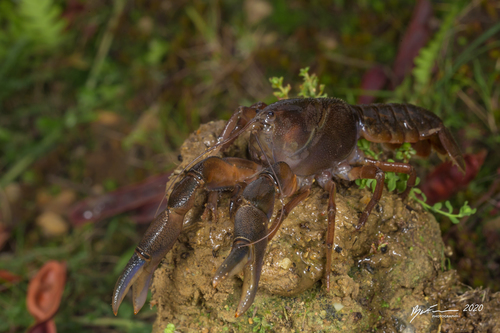
Central North Burrowing Crayfish
Engaeus granulatus
Photo: Photo: (c) Ryan Francis, all rights reserved, uploaded by Ryan Francis
Overview
Engaeus granulatus is a small freshwater crayfish in the family Parastacidae, a group of burrowing decapod crustaceans endemic to Australia. Like other members of its genus, it constructs and inhabits burrows in saturated soils, often extending down to the water table, and typically emerges at night or during wet conditions to forage on organic matter and detritus. Through burrowing, it aerates soil and contributes to nutrient cycling in its wetland habitat, and its burrows can provide microhabitat for other invertebrates.
The species is restricted to a limited area in the central north of its Australian range, associated with permanent rivers, streams, and inland wetlands where consistent soil moisture supports burrow construction. No reliable population trend data currently exist for this species.
Its Critically Endangered status reflects the cumulative pressure of multiple ongoing threats within its narrow range. Urban and residential development, agricultural expansion (both cropping and livestock grazing), and road and rail infrastructure have fragmented and degraded its habitat. Water management activities and dam construction alter stream flow and soil saturation critical to burrow viability, while agricultural runoff and other pollution sources affect water quality.
Fire and fire suppression practices, invasive species, and broader habitat modification compound these pressures, leaving little undisturbed habitat.
Conservation attention for burrowing crayfish in this region has generally focused on habitat protection measures, restrictions on land clearing near waterways, and monitoring of remaining populations, though species-specific programs for Engaeus granulatus are not well documented in available records.
Given its restricted distribution and the ongoing, multi-faceted nature of habitat threats, the species' outlook remains precarious. Without targeted monitoring and habitat safeguards, continued degradation of its wetland and stream habitat is likely to further constrain its already limited range.
The Central North Burrowing Crayfish is mainly threatened by the loss and disturbance of its wetland and streamside burrows as land is converted for housing, crop farming, and livestock grazing, along with damage from roads, dams, and water management changes. It also faces harm from fires, pollution from farms and other sources, and competition or habitat interference from invasive species. These pressures are all currently ongoing, suggesting the threats remain steady rather than clearly increasing or decreasing.
Habitat
Conservation measures underway
Other threatened species in PARASTACIDAE
Threatened in Australia
Frequently asked questions
Why is Central North Burrowing Crayfish classified as Critically Endangered?
Where does Central North Burrowing Crayfish live?
What are the main threats to Central North Burrowing Crayfish?
Get weekly conservation intelligence
One short digest a week of the most striking species and country data we ship, plus breaking conservation news paired with our database where it matters.
Free, no spam. One-click unsubscribe in every email.