Earth-cup Flapwort
Nardia geoscyphus
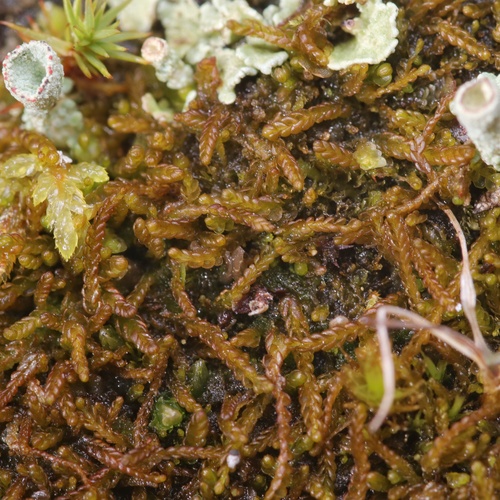
Earth-cup Flapwort (Nardia geoscyphus) is a small, leafy liverwort characterized by its distinctive cup-shaped reproductive structures and flattened, scale-like leaves arranged in two rows along creeping stems. This bryophyte forms thin, dark green to brownish mats on soil and rock surfaces, playing a crucial role in preventing erosion and creating microhabitats for other small organisms in its ecosystem.
31
Countries
Photo: iNaturalist: (c) Johannes Merz, some rights reserved (CC BY-NC-ND), uploaded by Johannes Merz
Taxonomy & Classification
Kingdom
Plantae
Phylum
Marchantiophyta
Class
Jungermanniopsida
Order
Jungermanniales
Family
Gymnomitriaceae
Genus
Nardia
Earth-cup Flapwort belongs to the family Gymnomitriaceae, order Jungermanniales, within the Jungermanniopsida class.
Species Profile
Earth-cup Flapwort (Nardia geoscyphus) is a small, leafy liverwort characterized by its distinctive cup-shaped reproductive structures and flattened, scale-like leaves arranged in two rows along creeping stems. This bryophyte forms thin, dark green to brownish mats on soil and rock surfaces, playing a crucial role in preventing erosion and creating microhabitats for other small organisms in its ecosystem.
Earth-cup Flapwort (Nardia geoscyphus) is critically endangered due to its extremely limited distribution and vulnerability to habitat degradation. This rare bryophyte species faces severe threats from climate change, habitat destruction, and human disturbance to its specialized microhabitat requirements.
Key Facts
Habitat & Distribution
Earth-cup Flapwort grows on moist, acidic soil banks, particularly along stream edges and in shaded ravines where consistent humidity levels are maintained. It is also found on damp, north-facing rock ledges and cliff faces in montane regions where water seepage provides the necessary moisture.
Threats
IUCN Red List: Critically Endangered
Earth-cup Flapwort (Nardia geoscyphus) is critically endangered due to its extremely limited distribution and vulnerability to habitat degradation. This rare bryophyte species faces severe threats from climate change, habitat destruction, and human disturbance to its specialized microhabitat requirements.
Climate change and altered precipitation patterns
Habitat loss and degradation
Air pollution and acid deposition
Human disturbance and trampling
Invasive species competition
Found in 31 Countries
National vs Global Threat Status
How this species is assessed at the national level compared to its IUCN global status (CR).
| Country | National Status | Global Status | Comparison |
|---|---|---|---|
| EU | LCLeast Concern | CRCritically Endangered | Lower local risk |
| EU | LCLeast Concern | CRCritically Endangered | Lower local risk |
National Red List data sourced from the National Red List Project (nationalredlist.org, ZSL) and country-specific Red List authorities.
Community Sightings
Report a sightingNo community sightings yet. Be the first to report!
Sources & Attribution
How to Cite
IUCN: IUCN (2025). The IUCN Red List of Threatened Species. Version 2025-1. Available at: https://www.iucnredlist.org. doi:10.2305/IUCN.UK.2025-1.RLTS
GBIF: GBIF.org (2025). GBIF Home Page. Available at: https://www.gbif.org
National Red Lists: ZSL (2025). National Red List. Zoological Society of London. Available at: https://www.nationalredlist.org
This page: SpeciesRadar (2025). Earth-cup Flapwort (Nardia geoscyphus). SpeciesRadar: Intelligence for Earth's Biodiversity. Available at: https://speciesradar.org/species/earth-cup-flapwort