Arctic Rustwort
Marsupella arctica
Overview
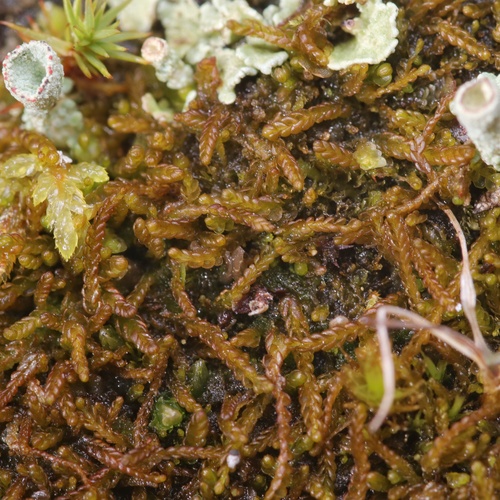
Arctic Rustwort (Marsupella arctica) is a diminutive liverwort species classified as Critically Endangered by the IUCN, representing one of the most imperiled bryophytes in the Arctic region. This small, leafy liverwort forms dense, rust-colored to brownish mats typically measuring just 1-2 centimeters in height, with distinctive deeply bifid leaves that overlap in a characteristic pattern. The species exhibits a striking reddish-brown coloration that intensifies during dry periods, giving rise to its common name.
Arctic Rustwort occupies extremely specialized microhabitats within the high Arctic tundra, primarily colonizing mineral-rich soil patches, crevices in limestone and calcareous rocks, and areas with late-lying snow patches that provide consistent moisture during the brief growing season. Its known distribution is remarkably restricted, documented from fewer than ten locations across the Canadian Arctic Archipelago, northern Greenland, and possibly Svalbard, making it one of the rarest bryophytes in the circumpolar Arctic. The species demonstrates remarkable physiological adaptations to extreme cold, capable of surviving temperatures below -40°C and resuming photosynthesis rapidly during brief thaw periods.
Arctic Rustwort reproduces primarily through fragmentation, as sexual reproduction appears extremely rare in the harsh Arctic conditions. Recent botanical surveys have renewed scientific interest in this species, with specialized bryological expeditions specifically targeting potential habitat areas, offering hope for discovering additional populations and better understanding its ecological requirements for future conservation planning.
Arctic Rustwort faces severe threats from rapidly accelerating climate change in the Arctic, where temperatures are rising twice as fast as the global average, fundamentally altering the species' specialized snow-patch and permafrost-dependent microhabitats. The increasing frequency of freeze-thaw cycles disrupts the stable soil conditions this liverwort requires, while shifting precipitation patterns threaten the delicate moisture balance essential for its survival. Additionally, the species' extremely limited distribution across fewer than ten known locations makes it exceptionally vulnerable to local disturbances and stochastic events that could eliminate entire populations.
Habitat
Arctic Rustwort inhabits highly specialized microhabitats in the high Arctic tundra, particularly favoring mineral-rich calcareous soils, limestone rock crevices, and areas adjacent to late-melting snow patches that provide consistent moisture. The species requires the unique combination of alkaline substrates, protection from extreme wind exposure, and the precise moisture regime created by slowly melting snow during the brief Arctic growing season.
Other threatened species in Gymnomitriaceae
Frequently asked questions
Why is Arctic Rustwort classified as Critically Endangered?
Where does Arctic Rustwort live?
What are the main threats to Arctic Rustwort?
Get weekly conservation intelligence
One short digest a week of the most striking species and country data we ship, plus breaking conservation news paired with our database where it matters.
Free, no spam. One-click unsubscribe in every email.