Dyeball
ENEndangered

Dyeball

Pisolithus arhizus

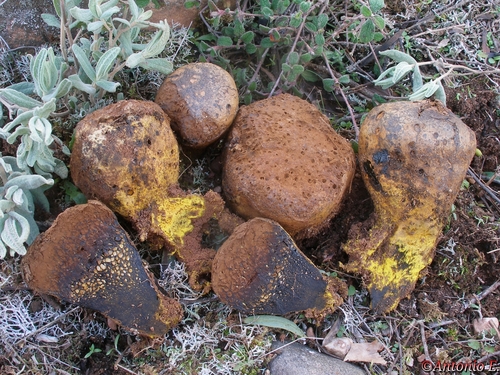
Pisolithus arhizus, commonly known as the dead man's foot, dyeball, pardebal, or Bohemian truffle, is a widespread earthball-like fungus.

84

Countries

Photo: iNaturalist: (c) Antonio Ezquerro Antoñana, all rights reserved, uploaded by Antonio Ezquerro Antoñana

01Classification

Taxonomy & Classification

Kingdom

Fungi

Phylum

Basidiomycota

Class

Agaricomycetes

Order

Boletales

Family

Sclerodermataceae

Genus

Pisolithus

Dyeball belongs to the family Sclerodermataceae, order Boletales, within the Agaricomycetes class.

02Description

Species Profile

Pisolithus arhizus, commonly known as the dead man's foot, dyeball, pardebal, or Bohemian truffle, is a widespread earthball-like fungus.

Habitat destruction through deforestation and urban development poses significant risks to Dyeball populations by eliminating host trees essential for its survival. Climate change and altered precipitation patterns further threaten this species by disrupting the delicate soil conditions and mycorrhizal networks it depends upon.

Key Facts

IUCN StatusEndangered (EN)
GroupFungi
03Habitat

Habitat & Distribution

Dyeball typically occurs in sandy, well-drained soils of pine forests, eucalyptus woodlands, and mixed coniferous forests. The species is commonly found along forest edges, in disturbed areas with exposed soil, and in plantations where it forms extensive underground networks with tree root systems.

TERRESTRIALMajor
04Threats

Threats

!

IUCN Red List: Endangered

Habitat destruction through deforestation and urban development poses significant risks to Dyeball populations by eliminating host trees essential for its survival. Climate change and altered precipitation patterns further threaten this species by disrupting the delicate soil conditions and mycorrhizal networks it depends upon.

Detailed threat classification data is sourced from IUCN assessments as they become available.

Community

Community Sightings

Report a sighting

No community sightings yet. Be the first to report!

07Sources

Sources & Attribution

How to Cite

IUCN: IUCN (2025). The IUCN Red List of Threatened Species. Version 2025-1. Available at: https://www.iucnredlist.org. doi:10.2305/IUCN.UK.2025-1.RLTS

GBIF: GBIF.org (2025). GBIF Home Page. Available at: https://www.gbif.org

This page: SpeciesRadar (2025). Dyeball (Pisolithus arhizus). SpeciesRadar: Intelligence for Earth's Biodiversity. Available at: https://speciesradar.org/species/dyeball

Full citation guide & data usage terms