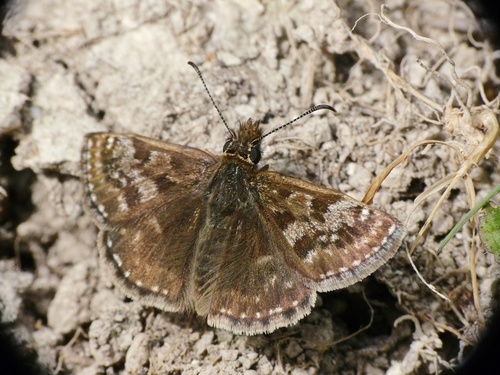
Dingy Skipper
CRCritically Endangered

Dingy Skipper

Erynnis tages

The Dingy Skipper is a small, brown butterfly with distinctive white-spotted forewings and a robust, moth-like appearance that distinguishes it from other skippers. This species plays a crucial ecological role as both a pollinator of wildflowers and as part of grassland food webs, with its caterpillars feeding exclusively on bird's-foot trefoil and other leguminous plants.

Photo: iNaturalist: (c) Ian Boyd, some rights reserved (CC BY-NC)

01Classification

Taxonomy & Classification

Kingdom

Animalia

Phylum

Arthropoda

Class

Insecta

Order

Lepidoptera

Family

Hesperiidae

Genus

Erynnis

Dingy Skipper belongs to the family Hesperiidae, order Lepidoptera, within the Insecta class.

02Description

Species Profile

The Dingy Skipper is a small, brown butterfly with distinctive white-spotted forewings and a robust, moth-like appearance that distinguishes it from other skippers. This species plays a crucial ecological role as both a pollinator of wildflowers and as part of grassland food webs, with its caterpillars feeding exclusively on bird's-foot trefoil and other leguminous plants.

The Dingy Skipper has experienced severe population declines across much of its range due to habitat loss and degradation of its specialized grassland habitats. Agricultural intensification, abandonment of traditional grazing practices, and urban development have eliminated or fragmented the flower-rich grasslands and scrubland edges this species requires for breeding and feeding.

Key Facts

IUCN StatusCritically Endangered (CR)
GroupInsects
03Habitat

Habitat & Distribution

Dingy Skippers inhabit chalk downs, limestone grasslands, coastal dunes, and railway embankments where bird's-foot trefoil grows abundantly. They require a mosaic of short, grazed turf for egg-laying and longer grass areas that provide shelter and nectar sources.

04Threats

Threats

!

IUCN Red List: Critically Endangered

The Dingy Skipper has experienced severe population declines across much of its range due to habitat loss and degradation of its specialized grassland habitats. Agricultural intensification, abandonment of traditional grazing practices, and urban development have eliminated or fragmented the flower-rich grasslands and scrubland edges this species requires for breeding and feeding.

Abandonment of traditional grazing management

HighOngoing

Habitat loss from agricultural intensification

HighOngoing

Urban development and infrastructure expansion

HighOngoing

Climate change altering suitable habitat conditions

MediumOngoing

Habitat fragmentation reducing population connectivity

MediumOngoing
07National Status

National vs Global Threat Status

How this species is assessed at the national level compared to its IUCN global status (CR).

CountryNational StatusGlobal StatusComparison
EULCLeast ConcernCRCritically EndangeredLower local risk

National Red List data sourced from the National Red List Project (nationalredlist.org, ZSL) and country-specific Red List authorities.

Community

Community Sightings

Report a sighting

No community sightings yet. Be the first to report!

07Sources

Sources & Attribution

How to Cite

IUCN: IUCN (2025). The IUCN Red List of Threatened Species. Version 2025-1. Available at: https://www.iucnredlist.org. doi:10.2305/IUCN.UK.2025-1.RLTS

GBIF: GBIF.org (2025). GBIF Home Page. Available at: https://www.gbif.org

National Red Lists: ZSL (2025). National Red List. Zoological Society of London. Available at: https://www.nationalredlist.org

This page: SpeciesRadar (2025). Dingy Skipper (Erynnis tages). SpeciesRadar: Intelligence for Earth's Biodiversity. Available at: https://speciesradar.org/species/dingy-skipper

Full citation guide & data usage terms