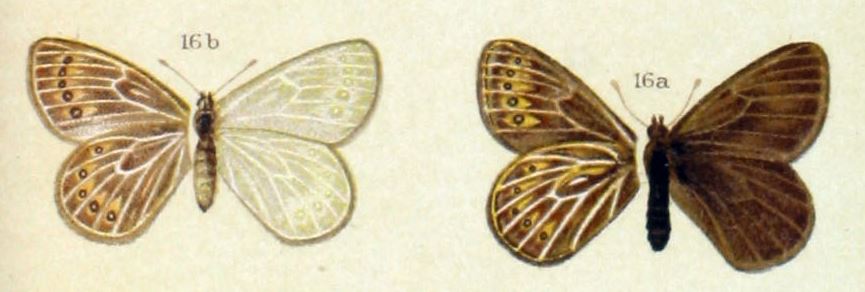
Dewy Ringlet
Erebia pandrose
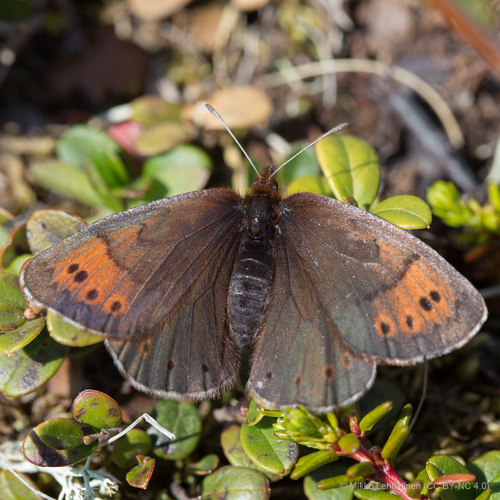
Erebia pandrose, the dewy ringlet, is a member of the subfamily Satyrinae of the family Nymphalidae. It is found from the Arctic areas of northern Europe, the Pyrenees, Alps, the Apennine Mountains, the Carpathian Mountains, Kola Peninsula and Kanin Peninsula, part of the Ural and the Altai and Sayan Mountains up to Mongolia.
Photo: iNaturalist: (c) Mikko Lehikoinen, some rights reserved (CC BY-NC), uploaded by Mikko Lehikoinen
Taxonomy & Classification
Kingdom
Animalia
Phylum
Arthropoda
Class
Insecta
Order
Lepidoptera
Family
Nymphalidae
Genus
Erebia
Dewy Ringlet belongs to the family Nymphalidae, order Lepidoptera, within the Insecta class.
Species Profile
Erebia pandrose, the dewy ringlet, is a member of the subfamily Satyrinae of the family Nymphalidae. It is found from the Arctic areas of northern Europe, the Pyrenees, Alps, the Apennine Mountains, the Carpathian Mountains, Kola Peninsula and Kanin Peninsula, part of the Ural and the Altai and Sayan Mountains up to Mongolia.
The Dewy Ringlet (Erebia pandrose) faces severe population declines primarily due to climate change impacts on its high-altitude alpine habitats. Rising temperatures are causing upward shifts in vegetation zones and reducing the availability of suitable cool, moist grassland habitats that this specialized butterfly requires. Habitat fragmentation and degradation from human activities further compound these climate-driven threats.
Key Facts
Threats
IUCN Red List: Critically Endangered
The Dewy Ringlet (Erebia pandrose) faces severe population declines primarily due to climate change impacts on its high-altitude alpine habitats. Rising temperatures are causing upward shifts in vegetation zones and reducing the availability of suitable cool, moist grassland habitats that this specialized butterfly requires. Habitat fragmentation and degradation from human activities further compound these climate-driven threats.
Climate change and warming temperatures
Habitat loss and fragmentation of alpine grasslands
Upward shift of vegetation zones reducing suitable habitat
Overgrazing by livestock in mountain pastures
Tourism and recreational activities in alpine areas
National vs Global Threat Status
How this species is assessed at the national level compared to its IUCN global status (CR).
| Country | National Status | Global Status | Comparison |
|---|---|---|---|
| EU | LCLeast Concern | CRCritically Endangered | Lower local risk |
| EU | LCLeast Concern | CRCritically Endangered | Lower local risk |
National Red List data sourced from the National Red List Project (nationalredlist.org, ZSL) and country-specific Red List authorities.
Community Sightings
Report a sightingNo community sightings yet. Be the first to report!
Sources & Attribution
How to Cite
IUCN: IUCN (2025). The IUCN Red List of Threatened Species. Version 2025-1. Available at: https://www.iucnredlist.org. doi:10.2305/IUCN.UK.2025-1.RLTS
GBIF: GBIF.org (2025). GBIF Home Page. Available at: https://www.gbif.org
National Red Lists: ZSL (2025). National Red List. Zoological Society of London. Available at: https://www.nationalredlist.org
This page: SpeciesRadar (2025). Dewy Ringlet (Erebia pandrose). SpeciesRadar: Intelligence for Earth's Biodiversity. Available at: https://speciesradar.org/species/dewy-ringlet