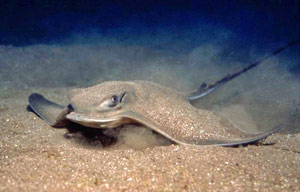
Common Eagle Ray
Myliobatis aquila
Photo: Wikimedia Commons (CC) via https://en.wikipedia.org/wiki/Common_eagle_ray
Overview
Status: Critically Endangered | Population trend: Decreasing
The common eagle ray is a large cartilaginous fish characterized by a rhomboid pectoral disc, a protruding duck-bill-shaped snout, and a long whip-like tail. It swims using undulating wing-like motions of its pectoral fins and is typically found gliding over open bottoms in search of prey. Like other myliobatids, it feeds primarily on benthic invertebrates—mollusks, crustaceans, and worms—using flattened, plate-like teeth to crush hard-shelled prey.
As a mid-level predator, it plays a role in structuring benthic invertebrate communities and serves as prey for larger sharks.
This species has an extensive distribution spanning the Eastern Atlantic (from Norway and the UK south to Namibia and South Africa), the Mediterranean, and parts of the Indo-Pacific and Western Atlantic, with records from over 70 countries. It occupies marine coastal and oceanic waters, typically over sandy or muddy substrates in shelf environments.
The species faces cumulative pressure from commercial fishing bycatch, particularly in bottom trawl and gillnet fisheries, which affect it across much of its range. Coastal habitat degradation from urban development, aquaculture, tourism infrastructure, and dam-related alterations to coastal hydrology compounds these losses. Marine pollution, including wastewater and agricultural runoff, further degrades nursery and foraging habitat.
Targeted and incidental hunting also continues in parts of its range.
Some populations fall within Marine Protected Areas and are subject to regional fisheries bycatch regulations, though enforcement and species-specific management remain limited across much of its range. Given ongoing habitat degradation and largely unmanaged fishing pressure, the population is expected to continue declining without stronger, range-wide protective measures.
The Common Eagle Ray is mainly threatened by fishing, both as an accidental catch in bottom trawls and gillnets and as a deliberate target, along with damage to its coastal habitats from construction, tourism development, fish and shellfish farming, and pollution from wastewater, farming runoff, and oil and gas activity. Dams and water management projects also disrupt the coastal and estuarine areas it depends on. All of these pressures are ongoing and show no signs of easing.
Habitat
Myliobatis aquila inhabits coastal waters, sandy and muddy bottoms, and seagrass beds from the surface to depths of 200 meters. The species prefers temperate and subtropical waters of the Mediterranean Sea and Eastern Atlantic, often found in shallow bays and estuaries where it feeds on benthic invertebrates.
Conservation measures underway
Other threatened species in MYLIOBATIDAE

Threatened in Albania

Frequently asked questions
Why is Common Eagle Ray classified as Critically Endangered?
Where does Common Eagle Ray live?
What are the main threats to Common Eagle Ray?
Get weekly conservation intelligence
One short digest a week of the most striking species and country data we ship, plus breaking conservation news paired with our database where it matters.
Free, no spam. One-click unsubscribe in every email.