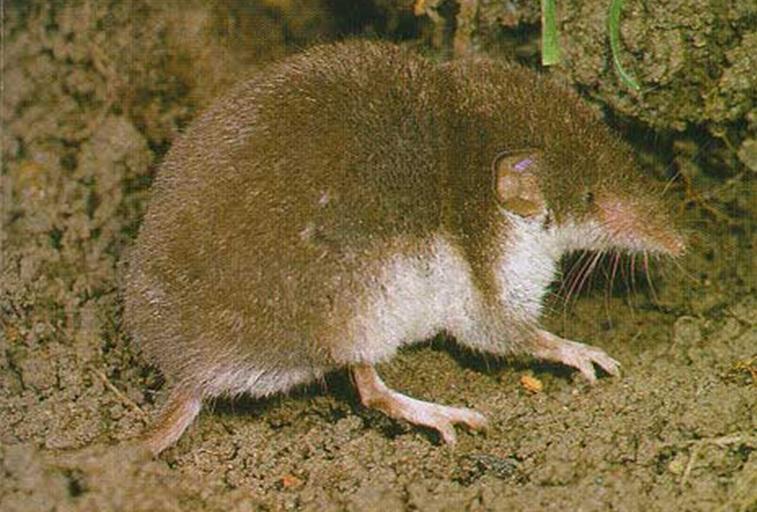
Christmas Island Shrew
Crocidura trichura
The Christmas Island shrew, also known as the Christmas Island musk-shrew, is an extinct species of shrew from Christmas Island. It was variously placed as subspecies of the Asian gray shrew or the Southeast Asian shrew, but morphological differences and the great distances between the distribution of these species indicate that the Christmas Island shrew was a distinct species.
Photo: Wikimedia Commons (CC) via https://en.wikipedia.org/wiki/Christmas_Island_shrew
Taxonomy & Classification
Kingdom
Animalia
Phylum
Chordata
Class
Mammalia
Order
Soricomorpha
Family
Soricidae
Genus
Crocidura
Christmas Island Shrew belongs to the family Soricidae, order Soricomorpha, within the Mammalia class.
Species Profile
The Christmas Island shrew, also known as the Christmas Island musk-shrew, is an extinct species of shrew from Christmas Island. It was variously placed as subspecies of the Asian gray shrew or the Southeast Asian shrew, but morphological differences and the great distances between the distribution of these species indicate that the Christmas Island shrew was a distinct species.
The Christmas Island Shrew faces severe threats primarily from habitat destruction and degradation caused by invasive species and human activities on Christmas Island. The species' extremely limited range makes it particularly vulnerable to any environmental changes, with invasive ants, cats, and habitat clearing for development posing the greatest risks to its survival.
Key Facts
Habitat & Distribution
The Christmas Island shrew was a terrestrial animal that occupied tall plateau rainforests with deep soil, as well as the shallow soil of terrace rainforests. It remains unknown if the species could live in secondary growth. This shrew fed primarily on small beetles and used holes in rocks and tree roots for shelter.
Threats
IUCN Red List: Critically Endangered
The Christmas Island Shrew faces severe threats primarily from habitat destruction and degradation caused by invasive species and human activities on Christmas Island. The species' extremely limited range makes it particularly vulnerable to any environmental changes, with invasive ants, cats, and habitat clearing for development posing the greatest risks to its survival.
Habitat destruction and fragmentation
Invasive species (particularly yellow crazy ants)
Predation by introduced mammals (cats, rats)
Small population size and restricted range
Mining and infrastructure development
National vs Global Threat Status
How this species is assessed at the national level compared to its IUCN global status (CR).
| Country | National Status | Global Status | Comparison |
|---|---|---|---|
| AU | CRCritically Endangered | CRCritically Endangered | Same |
National Red List data sourced from the National Red List Project (nationalredlist.org, ZSL) and country-specific Red List authorities.
Community Sightings
Report a sightingNo community sightings yet. Be the first to report!
Sources & Attribution
How to Cite
IUCN: IUCN (2025). The IUCN Red List of Threatened Species. Version 2025-1. Available at: https://www.iucnredlist.org. doi:10.2305/IUCN.UK.2025-1.RLTS
GBIF: GBIF.org (2025). GBIF Home Page. Available at: https://www.gbif.org
National Red Lists: ZSL (2025). National Red List. Zoological Society of London. Available at: https://www.nationalredlist.org
This page: SpeciesRadar (2025). Christmas Island Shrew (Crocidura trichura). SpeciesRadar: Intelligence for Earth's Biodiversity. Available at: https://speciesradar.org/species/christmas-island-shrew