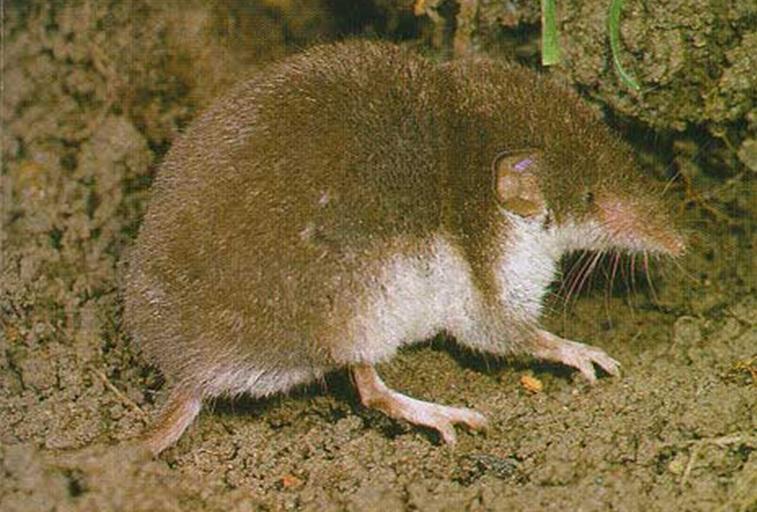
Eurasian Water Shrew
Neomys fodiens
The Eurasian water shrew, known in the United Kingdom as the water shrew, is a relatively large shrew, up to 10 cm (4 in) long, with a tail up to three-quarters as long again. It has short, dark fur, often with a few white tufts, a white belly, and a few stiff hairs around the feet and tail.
Photo: Wikimedia Commons (CC) via https://en.wikipedia.org/wiki/Eurasian_water_shrew
Taxonomy & Classification
Kingdom
Animalia
Phylum
Chordata
Class
Mammalia
Order
Soricomorpha
Family
Soricidae
Genus
Neomys
Eurasian Water Shrew belongs to the family Soricidae, order Soricomorpha, within the Mammalia class.
Species Profile
The Eurasian water shrew, known in the United Kingdom as the water shrew, is a relatively large shrew, up to 10 cm (4 in) long, with a tail up to three-quarters as long again. It has short, dark fur, often with a few white tufts, a white belly, and a few stiff hairs around the feet and tail. It lives close to fresh water, hunting aquatic prey in the water and nearby.
The Eurasian Water Shrew faces significant population declines primarily due to habitat degradation and loss of clean freshwater environments. Water pollution, agricultural runoff, and wetland drainage have severely impacted the quality of riparian habitats essential for this semi-aquatic species.
Key Facts
Habitat & Distribution
Neomys fodiens in its habitat The Eurasian water shrew is found throughout Europe with the exception of Iceland, Ireland, certain Mediterranean islands and the Balkans. It rarely strays far from water and is found in and around ditches, streams, ponds, watercress beds, fish ponds, damp meadows and rough bushy ground adjoining water.
Threats
IUCN Red List: Endangered
The Eurasian Water Shrew faces significant population declines primarily due to habitat degradation and loss of clean freshwater environments. Water pollution, agricultural runoff, and wetland drainage have severely impacted the quality of riparian habitats essential for this semi-aquatic species.
Water pollution and contamination
Wetland drainage and habitat loss
Agricultural intensification and runoff
Climate change affecting water levels
Stream channelization and modification
National vs Global Threat Status
How this species is assessed at the national level compared to its IUCN global status (EN).
| Country | National Status | Global Status | Comparison |
|---|---|---|---|
| EU | LCLeast Concern | ENEndangered | Lower local risk |
| EU | LCLeast Concern | ENEndangered | Lower local risk |
National Red List data sourced from the National Red List Project (nationalredlist.org, ZSL) and country-specific Red List authorities.
Community Sightings
Report a sightingNo community sightings yet. Be the first to report!
Sources & Attribution
How to Cite
IUCN: IUCN (2025). The IUCN Red List of Threatened Species. Version 2025-1. Available at: https://www.iucnredlist.org. doi:10.2305/IUCN.UK.2025-1.RLTS
GBIF: GBIF.org (2025). GBIF Home Page. Available at: https://www.gbif.org
National Red Lists: ZSL (2025). National Red List. Zoological Society of London. Available at: https://www.nationalredlist.org
This page: SpeciesRadar (2025). Eurasian Water Shrew (Neomys fodiens). SpeciesRadar: Intelligence for Earth's Biodiversity. Available at: https://speciesradar.org/species/eurasian-water-shrew