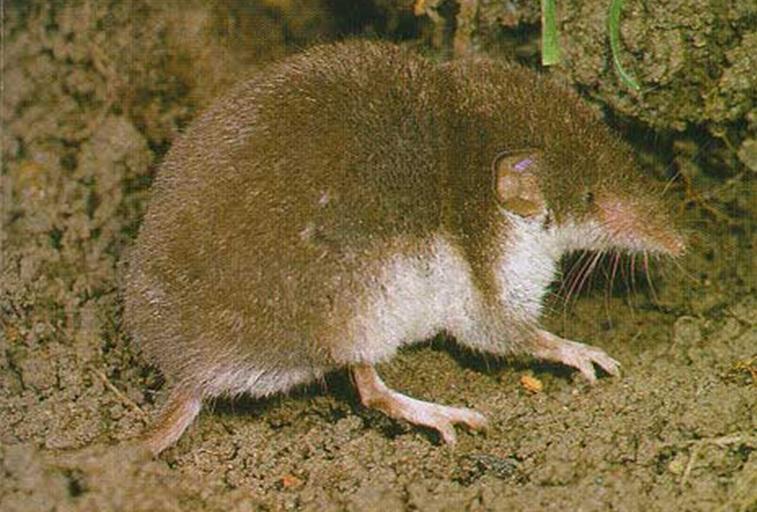
Bicolored Shrew
Crocidura leucodon
The bicolored shrew or bicoloured white-toothed shrew is a species of mammal in the family Soricidae. It is found in eastern, central and southern Europe and in western Asia.
Photo: Wikimedia Commons (CC) via https://en.wikipedia.org/wiki/Bicolored_shrew
Taxonomy & Classification
Kingdom
Animalia
Phylum
Chordata
Class
Mammalia
Order
Soricomorpha
Family
Soricidae
Genus
Crocidura
Bicolored Shrew belongs to the family Soricidae, order Soricomorpha, within the Mammalia class.
Species Profile
The bicolored shrew or bicoloured white-toothed shrew is a species of mammal in the family Soricidae. It is found in eastern, central and southern Europe and in western Asia. It is a nocturnal species and feeds on insects and other small creatures. Several litters of young are born during the warmer months of the year in a nest of dry grasses in a concealed location.
The Bicolored Shrew faces significant population declines primarily due to habitat loss and fragmentation from agricultural expansion and urbanization across its European range. Climate change and intensive farming practices that reduce invertebrate prey availability further threaten remaining populations.
Key Facts
Habitat & Distribution
The bicoloured white-toothed shrew is found in eastern, central and southern Europe but not south western France, the Iberian Peninsula or southern Italy. It is also native to the Crimea, the Caucasus, Turkestan and Iran. In the Alps it is found at altitudes of up to . The habitat of this shrew is pastureland, cultivated fields, gardens, hedgerows, piles of rubble and rubbish heaps. It sometimes...
Threats
IUCN Red List: Endangered
The Bicolored Shrew faces significant population declines primarily due to habitat loss and fragmentation from agricultural expansion and urbanization across its European range. Climate change and intensive farming practices that reduce invertebrate prey availability further threaten remaining populations.
Agricultural intensification and habitat conversion
Urban development and infrastructure expansion
Climate change impacts on prey availability
Habitat fragmentation
Pesticide use reducing invertebrate prey
National vs Global Threat Status
How this species is assessed at the national level compared to its IUCN global status (EN).
| Country | National Status | Global Status | Comparison |
|---|---|---|---|
| EU | LCLeast Concern | ENEndangered | Lower local risk |
| EU | LCLeast Concern | ENEndangered | Lower local risk |
National Red List data sourced from the National Red List Project (nationalredlist.org, ZSL) and country-specific Red List authorities.
Community Sightings
Report a sightingNo community sightings yet. Be the first to report!
Sources & Attribution
How to Cite
IUCN: IUCN (2025). The IUCN Red List of Threatened Species. Version 2025-1. Available at: https://www.iucnredlist.org. doi:10.2305/IUCN.UK.2025-1.RLTS
GBIF: GBIF.org (2025). GBIF Home Page. Available at: https://www.gbif.org
National Red Lists: ZSL (2025). National Red List. Zoological Society of London. Available at: https://www.nationalredlist.org
This page: SpeciesRadar (2025). Bicolored Shrew (Crocidura leucodon). SpeciesRadar: Intelligence for Earth's Biodiversity. Available at: https://speciesradar.org/species/bicolored-shrew