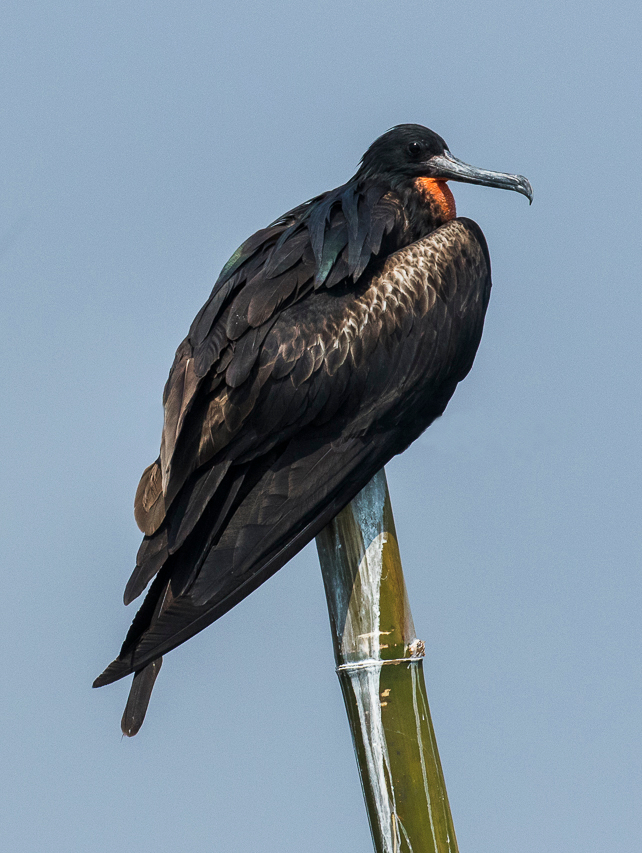
Christmas Island Frigatebird
VU

Christmas Island Frigatebird

Fregata andrewsi

DecliningENAU

Photo: Wikimedia Commons (CC) via https://en.wikipedia.org/wiki/Christmas_frigatebird

Overview

A large seabird with predominantly black plumage, a hooked bill, and long, angular wings spanning up to 2 metres, males of this species display an inflatable red throat pouch during breeding displays. Females are larger and show a white breast patch. Highly aerial, these frigatebirds rarely land on water, instead snatching flying fish and squid from the surface or harassing other seabirds to steal their catch, a behaviour known as kleptoparasitism.

As apex aerial predators within tropical seabird colonies, they help regulate prey populations and serve as indicators of marine ecosystem health.

This species breeds almost exclusively on Christmas Island, in the Indian Ocean, nesting in tall rainforest canopy near cliffs and coastal terrain. Outside the breeding season, individuals disperse widely across Southeast Asian and Indian Ocean waters, with records from Indonesia, Thailand, China, and India.

Its restricted breeding range makes it highly vulnerable. Phosphate mining and quarrying on Christmas Island have historically destroyed nesting habitat, while fire, invasive species such as the yellow crazy ant, and land clearing for agriculture continue to degrade forest habitat. Marine threats include entanglement in fishing gear, competition for fish stocks, pollution from industrial effluents, and oil contamination.

Conservation efforts include habitat protection within Christmas Island National Park, monitoring of breeding colonies, and control programs targeting invasive ants that disrupt forest ecosystems. Mining regulations have also been tightened to limit further habitat loss near nesting sites.

With a global population estimated in the low thousands of breeding pairs, the species remains classified as Vulnerable, with a continuing decreasing trend. Its dependence on a single breeding location makes it especially susceptible to localized disturbances, and its long-term outlook remains uncertain without sustained habitat protection and invasive species control.

The Christmas Island Frigatebird faces serious pressure from land clearing for mining and farming, forest loss from logging, and habitat destruction caused by wildfires. It is also affected by pollution from industrial waste and other contaminants, disturbance from fishing activities, and competition or predation from invasive species introduced to its habitat. These ongoing threats appear to be continuing at a steady pace, with no clear signs of significant increase or decrease.

Threat summary

Habitat

Marine oceanic· majorMarine coastal/supratidal· majorMarine neritic· major

Conservation measures underway

Site/area protectionSpecies managementSpecies recoveryLegislation

Frequently asked questions

Why is Christmas Island Frigatebird classified as Vulnerable?
Christmas Island Frigatebird is classified as Vulnerable because the population is declining and the species faces a high risk of extinction in the medium-term future if current pressures continue. The Christmas Island Frigatebird faces serious pressure from land clearing for mining and farming, forest loss from logging, and habitat destruction caused by wildfires. It is also affected by pollution from industrial waste and other contaminants, disturbance from fishing activities, and competition or predation from invasive species introduced to its habitat. These ongoing threats appear to be continuing at a steady pace, with no clear signs of significant increase or decrease.
Where does Christmas Island Frigatebird live?
Christmas Island Frigatebird occurs in Australia, China, Christmas Island, India, Indonesia, and Thailand. Country-level distribution data is sourced from the IUCN Red List and cross-referenced with GBIF occurrences.
What are the main threats to Christmas Island Frigatebird?
The main threats to Christmas Island Frigatebird are 11.1, 12.1, 2.1, and 3.2. The full IUCN-classified threat record for this species is detailed on the species page.

Get weekly conservation intelligence

One short digest a week of the most striking species and country data we ship, plus breaking conservation news paired with our database where it matters.

Free, no spam. One-click unsubscribe in every email.